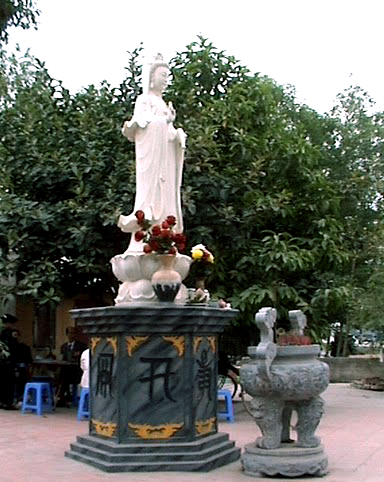
Phi Tướng Pagoda
Bắc Ninh(Chùa Phi Tướng)
Overview & history
Phi Tướng Pagoda (its formal name is Phi Tướng Đại Thiền Tự) also known as Tướng Pagoda, is located in Khương Tự quarter, Trí Quả ward, Bắc Ninh province. The pagoda belongs to the Tứ Pháp (Four Dharmas) pagoda system, first built around the 2nd century to the south of the centre of the ancient Luy Lâu citadel, and is part of the cluster of the earliest Buddhist relics in Vietnam.
Name
The formal name of the pagoda is Phi Tướng Đại Thiền Tự (Chinese characters: 非相大禪寺), but locals abbreviate it as Tướng Pagoda. The term "Phi Tướng" means "without form" (without shape), originating from the fact that the pagoda worships the deity Pháp Lôi, the Buddha in charge of thunder. "Lôi" (Chinese character: 雷) means "thunder". Today, there is a common misunderstanding that "lôi" means "lightning" (for example, "Thiên lôi"/Lôi Công is thought of as the "god of lightning"), whereas "đình" (Chinese character: 霆) actually means "lightning". "Lôi" refers only to sound, not to form, hence the pagoda is named Phi Tướng (Without Form). At the same time, the pagoda was built on the land of the old Thanh Tương village, colloquially known as Tướng village (according to the legend of the female general Biểu Phật Nương, a native of the village and attendant of the Trưng Sisters), so the name Phi Tướng is also a play on words connected to the local place name.
History
Phi Tướng Pagoda is part of the Tứ Pháp pagoda complex in Thuận Thành, all built at the same time. The books Đại Việt sử ký toàn thư, Việt sử lược, Lĩnh Nam chích quái, Thiền uyển tập anh, “Phong thổ Kinh Bắc”, Việt điện u linh, Đại Nam nhất thống chí all state that: The Tứ Pháp pagodas were first established in the Dâu - Luy Lâu area in the 2nd century AD.
According to the book Cổ châu pháp vân bổn hạnh ngũ lục, during the Eastern Jin dynasty (317-419), there was a Dharma Master named Tì-ni-đa-lưu-chi, an Indian, who, seeing that Buddhism was already understood in Nam Việt, came to study at Phi Tướng Pagoda and then resided at Pháp Vân Pagoda, teaching the Dharma. From then on, Buddhism flourished in Vietnam. Phi Tướng Pagoda was the first place Tỳ Ni Đa Lưu Chi set foot in upon arriving in Vietnam, located to the south of the ancient Luy Lâu citadel, with the formal name “Phi Tướng Đại Thiền Tự”.
The stele Phi Tướng tự bi ký, erected in the 18th year of Chính Hoà (1697), describes the restoration of the pagoda:
The pagoda still preserves many valuable ancient documents, including:
Royal Edict of the 4th year of Cảnh Hưng era, 1743
Royal Edict of the 44th year of Cảnh Hưng era, 1783
Royal Edict of the 2nd year of Minh Mạng era, 1821
Royal Edict of the 4th year of Thiệu Trị era, 1844
Royal Edict of the 3rd year of Tự Đức era, 1850
Royal Edict of the 2nd year of Đồng Khánh era, 1887
In addition, the pagoda has a bell dated to the 19th year of Minh Mạng (1839) and five ancient steles carved around the late Lê and early Nguyễn dynasties (including the stele from the 18th year of Chính Hòa - 1697). The Hậu đường bi ký stele (25th year of Tự Đức - 1873) records: "Nguyễn Văn Trường of Gia Lâm village, Gia Lâm district, Thuận An prefecture, donated 70 quan tiền, 200 bowls of rice, 1 sào of rice field, and also donated a house worth 500 quan tiền to be converted into the hậu đường (rear hall) for Buddha worship."
Thus, Tướng Pagoda was built on a large scale at the end of the 17th century, but by the mid-19th century had become dilapidated and ruined. The Ký kỵ bi lý stele, carved on the 16th day of the 12th month, 8th year of Tự Đức (1855), states: "Phi Tướng Pagoda to the south of Luy Lâu citadel, originally worshipping the Great King Buddha Pháp Lôi, is worshipped by three villages, but after many years has fallen into ruin." Another stele dated the 11th day of the 2nd month, 8th year of Tự Đức (1855) also records: "Now Nguyễn Thị Tân of Lũng Khê village has donated 50 quan tiền and 8 sào of rice field for incense and offerings." There is also a stele with its date chiselled off (possibly from the Tây Sơn period) recording the construction of the upper hall, the tam quan (three-entrance gate), and the restoration of the Nam Tào and Bắc Đẩu statues...
Pháp Lôi
The surviving royal edicts provide quite clear information about the history of the pagoda, as well as the deity worshipped: Đại Thánh Pháp Lôi Phật (the Venerable Saint Buddha Pháp Lôi, who is both a Saint and a Buddha). Among these, the oldest edict, dated the 27th day of the 3rd lunar month, 4th year of Cảnh Hưng (1743), contains the following content:
According to the legend of the Buddhist Mother Man Nương, a sacred dung tree was swept by storms along the Dâu river to Luy Lâu; locals retrieved it and carved four Buddha statues from it. When carving the third statue, thunder roared across the sky, so the statue was named Pháp Lôi. The Pháp Lôi statue was brought to Tướng village (Thanh Tương village) and Phi Tướng Pagoda was built to enshrine it. From then on, the Tứ Pháp statues were considered extremely sacred, blessing the agricultural communities of Vietnam with favourable weather; their fame for spiritual power reached even the emperors of the Jin dynasty in the north and later the Song dynasty, not just the Giao Chỉ region at that time.
The Pháp Lôi Buddha statue is worshipped in the upper hall of the pagoda. The statue has been recognised as National Treasure No. 10, batch 6 (2017), together with the other three statues of the Tứ Pháp set at Dâu Pagoda and Dàn Pagoda. The Buddha statue is carved in a meditative posture seated on a large wooden lotus pedestal carved with dragons, lacquered and gilded, with a body height of 1.45m, shoulder width 0.55m, thigh width 1.05m. The lotus pedestal is 0.25m high with three layers of plump petals. The statue has a feminine body, a full, serene face with a straight nose, willow-leaf eyebrows, eyes looking down compassionately, a smiling mouth, the right hand raised to chest level with fingers forming a mudra, the left hand resting palm-up on the thigh holding a "minh châu" (precious jewel); the whole body is painted with a plum-red lacquer, symbolising a sky full of clouds, rain, thunder and lightning.
Because the statue is carved with feminine features and, according to legend, the dung tree (from which the statue was carved) contained the spirit of Man Nương's daughter, the Pháp Lôi statue is called Bà Tướng (Lady Tướng), along with Bà Dâu (Dâu Pagoda), Bà Đậu (Đậu Pagoda), and Bà Dàn (Dàn Pagoda). The Dâu region festival (Hội Dâu) always includes a ritual procession of all four Lady statues to Dâu Pagoda.
Architecture
Tướng Pagoda is located next to Dâu market and on the other side of the ancient Dâu river.
On the tam quan (three-entrance gate) of the pagoda is a parallel couplet:
Phi Tướng môn tự, vọng giang thiên tạo, lập danh lam thắng cảnh
Thanh Khương thắng địa, Tứ Pháp hiển linh tích cách thụ khai quang
Which means:
The gate of Phi Tướng Pagoda looks out over the (Dâu) river, a natural scenic spot
The land of Thanh Khương is a sacred site, where the tree was opened up to reveal the spiritual power of the Tứ Pháp
The present-day Phi Tướng Pagoda is an architectural and sculptural work of the Lê Trung Hưng period. The Tam Bảo hall has a floor plan in the shape of the Chinese character "Công" (工), consisting of: a five-bay, two-wing tiền đường (front hall), a two-bay thiêu hương (incense hall), and a one-bay, two-wing thượng điện (upper hall) with four gracefully curving roofs. The tiền đường enshrines Zen master Tì-ni-đa-lưu-chi, the Ten Kings of Hell (Thập điện Diêm Vương), Dharma protectors (good and evil), and the Three Western Saints (Tam Thánh Tây Phương). In 1982, the tiền đường collapsed, leaving only the foundations. The upper hall dedicated to Buddha Pháp Lôi and one connecting bay remain.
The Tam Bảo hall in the rear is arranged as in typical northern Vietnamese pagodas, including: the Three Worlds Buddhas (Tam Thế), Chúa Ông, Thánh Hiền, Cửu Long, etc. In 2019, the pagoda was restored and repaired.
Photos
📷 Contribute photosVisiting tips
- Dress modestly; remove hats and keep quiet inside the main hall.
- Incense, flowers and offerings are usually sold right outside the gate; light an odd number of sticks (1 or 3).
- Most pagodas open from early morning to evening and are free to enter (some major sites charge a small scenic fee).
- Full-moon days, the 1st of the lunar month and Tet are very crowded; visit on weekday mornings for a quiet experience.
- Ask permission before photographing inside shrines; do not touch statues or altar objects.
Read more & references
Useful links to learn more before your visit:
Location
Coordinates: 21.03756, 106.04733
🧭 Directions on Google MapsReferences
- Vietnamese Wikipedia
- http://disanvanhoathuanthanh.vn/Tourism/Places/5/Chua-Phi-Tuong.html
- https://nld.com.vn/thoi-su/song-cung-thien-loi-giai-ma-ngoi-lang-troi-danh-20180711211642141.htm
- http://antgct.cand.com.vn/Khoa-hoc-Van-Minh/Bi-an-cua-thien-loi-309761/
- http://thegioidisan.vn/vi/ca-tru-thanh-tuong.html
- https://baophapluat.vn/dan-sinh/chuyen-la-ve-nhan-vat-vua-la-phat-vua-duoc-phong-thanh-313398.html
- http://www.hannom.org.vn/detail.asp?param=572&Catid=486
- http://bacninh.gov.vn/news/-/details/20182/le-hoi-chua-dau
- https://giacngo.vn/tuthienxahoi/xahoi/2011/03/30/737648/
- https://web.archive.org/web/20200605145629/http://bacninh.gov.vn/news/-/details/20182/le-hoi-chua-dau
Other pagodas in Bắc Ninh