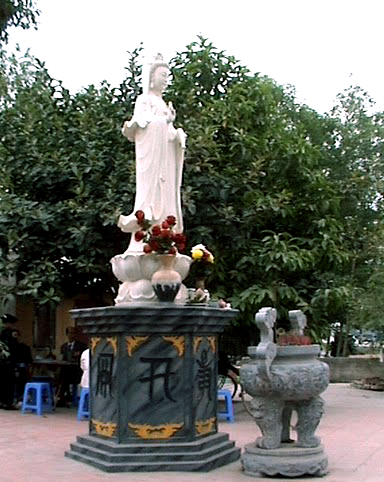
Vĩnh Nghiêm Pagoda (Bắc Ninh)
Bắc Ninh(formerly Bắc Giang)(Chùa Vĩnh Nghiêm (Bắc Ninh))

Overview & history
Vĩnh Nghiêm Pagoda, also known as Đức La Pagoda, is an ancient pagoda located in Đức La village, Tân An ward, Bắc Ninh province, Vietnam. The pagoda is recognised as a Buddhist centre, a place for training monks for the whole country, and the birthplace of the Three Patriarchs (Tam Tổ) of the Trúc Lâm Zen sect of Vietnamese Buddhism. In 2015, the pagoda was recognised as a Special National Monument.
History
In the past, Vĩnh Nghiêm Pagoda belonged to Đức La commune, Trí Yên canton, Lạng Giang prefecture, now Đức La hamlet, Tân An ward, Bắc Ninh province, so it is also called Đức La Pagoda and the festival here is called the La Festival. Vĩnh Nghiêm Pagoda is situated at the confluence of the Lục Nam and Thương rivers (called Phượng Nhãn junction). The pagoda faces the river junction, towards Lục Đầu Giang - Kiếp Bạc, in the Cẩm Lý region, the gateway to Yên Tử mountain. The pagoda is surrounded by mountains, including Cô Tiên mountain. Across the river is the royal residence of Trần Hưng Đạo and Kiếp Bạc Temple.
The pagoda's stele from the Trần dynasty reads: "When the Venerable Patriarch Điều Ngự Pháp Loa established this monastic forest, he also opened Đức La market. Princes, royal relatives, and lay devotees from all directions contributed to buying land in the local commune and other areas to offer incense and make perpetual offerings to the Three Jewels. This pagoda and Sùng Nghiêm Pagoda, altogether 72 monastic sites, their meritorious deeds were recorded together on the stele at Hoa Nghiêm Pagoda on Yên Tử mountain." Another stele erected at the pagoda states: "The Venerable Patriarch Điều Ngự (i.e. Trần Nhân Tông), when establishing this monastic forest (i.e. Vĩnh Nghiêm Pagoda), also opened the pagoda market. Princes, royal relatives, and lay devotees from all directions contributed much land to the pagoda, including land in the commune and in other areas."
Legend has it that Vĩnh Nghiêm Pagoda dates from the early reign of Lý Thái Tổ (1010–1028), with the formal name Vĩnh Nghiêm tự (永嚴寺). During the reign of King Trần Thánh Tông, many eminent monks practised here, so the pagoda was magnificently renovated. When King Trần Nhân Tông abdicated and became a monk, he came to Vĩnh Nghiêm Pagoda and Ngọa Vân Pagoda (Yên Tử) to receive ordination, taking the dharma name Hương Vân Đại Đầu Đà, and founded the Vietnamese Zen sect. Hương Vân, together with his two disciples Pháp Loa and Huyền Quang, established and perfected the Vietnamese Zen sect known as the Three Patriarchs (Tam Tổ).
Originally, Ngọa Vân Pagoda was presided over by Master Hiện Quang, but after Hiện Quang passed away, it ceased to exist. As Yên Tử was the homeland of the Trần dynasty and where King Trần Thái Tông founded the Trúc Lâm sect, Hương Vân Trần Nhân Tông received ordination at both Vĩnh Nghiêm Pagoda and there. Pháp Loa, who received the dharma from Hương Vân, travelled widely to preach and lectured on the book "Thiền Uyển Truyền Đăng Lục". When Hương Vân passed away, Pháp Loa conducted the cremation, built a stupa on Yên Tử mountain, and conferred the posthumous title "Great Saint of the Trần Dynasty, Trúc Lâm Ascetic, Serene Wisdom, Enlightened King, Điều Ngự Patriarch Buddha" (Đại Thánh Trần Triều Trúc Lâm Đầu Đà Tĩnh Tuệ Giác Hoàng Điều Ngự Tổ Phật), known as the First Patriarch of Trúc Lâm. Then Pháp Loa returned to Vĩnh Nghiêm Pagoda as abbot, making it a Buddhist centre, training monks, organising the monastic hierarchy, and directing pagodas nationwide. Pháp Loa had 1,300 statues cast, was in charge of regulating the monastic community, which numbered over 15,000 monks and nuns and disciples, of whom more than 3,000 attained the dharma, and established 200 dharma halls... He also compiled the books "Đoạn Sách Lục, Tham Thiền, Yếu Chỉ". In 1330, Pháp Loa handed over to Huyền Quang, who had moved to Quỳnh Lâm Pagoda as abbot, and a few months later passed away, receiving the title "Tĩnh Chi Tôn Giả" and becoming the Second Patriarch of Trúc Lâm.
As for Huyền Quang, he was originally from Vạn Tải village in the Vũ Ninh region (Bắc Ninh), son of Lý Ôn Hòa (an official under Lý Thần Tông), and passed the imperial examination as Trạng nguyên under the Trần dynasty. While still an official, Huyền Quang escorted the king to Vĩnh Nghiêm Pagoda, where he heard Pháp Loa preach, became enlightened, and twice submitted petitions to resign from office. Hương Vân then appointed him abbot of Vĩnh Nghiêm Pagoda. Huyền Quang compiled major works: Chư Phẩm Kinh, Công Văn Tập, printed Buddhist scriptures, and distributed them to the poor. He passed away in 1334, receiving the title "Trúc Lâm Third Great Dharma Master Huyền Quang Tôn Giả" and became the Third Patriarch of Trúc Lâm. Thus, before Hương Vân went to Yên Tử and Pháp Loa to Quỳnh Lâm Pagoda, both had served as abbots at Vĩnh Nghiêm Pagoda. All three Trúc Lâm Patriarchs—Hương Vân (First Patriarch), Pháp Loa (Second Patriarch), and Huyền Quang (Third Patriarch)—used Vĩnh Nghiêm Pagoda as their centre for teaching the dharma. Currently, in the First Patriarch Hall, there are still three statues of the Trúc Lâm Patriarchs: in the shrine is the statue of Hương Vân Trần Nhân Tông, outside are the statues of Pháp Loa and Huyền Quang. This place was the ancestral land of Buddhism during the Trần dynasty, training many monks.
Later, some monks from the North went to Sài Gòn and built a second Vĩnh Nghiêm Pagoda at 339 Nam Kỳ Khởi Nghĩa Street, Ward 7, District 3, Ho Chi Minh City. This is a very famous pagoda in Vietnam. Currently, this pagoda is even more famous than the original Vĩnh Nghiêm Pagoda (Bắc Ninh).
Architecture
Vĩnh Nghiêm Pagoda is large in scale, situated on a plot of about 1 hectare, with the grounds surrounded by dense bamboo hedges. The pagoda is built along a single axis, facing southeast, and consists of four main blocks: the Thiên đường Hall, the Upper Hall (Thượng điện), the First Patriarch Hall (nhà Tổ đệ nhất), the bell tower, the Second Patriarch Hall (nhà tổ đệ nhị), and several other structures. At the entrance is the triple-gate (tam quan) built of brick; after passing through it and walking over 100 metres, one reaches the Bái đường (Hộ Pagoda). Since the pagoda's founding, pines have been planted along both sides of the path to form a monastic forest, with some trees nearly 1 metre in diameter. In the pagoda courtyard stands a large six-sided stele erected in the 7th year of Hoằng Định (1606), recording the restoration of the pagoda that year. Opposite the ancient stele is the stupa garden, which contains the tombs of five renowned monks: Phù Lãng Trung pháp (Dharma name Sa môn), Thông Duệ ứng Duyên, Thanh Quý, Tịnh Phương Sa môn, Thanh Hanh, and several other stupas.
The first block, in the shape of the character "Công" (工), comprises the Bái đường, Thiêu hương Hall, and Upper Hall, designed in a grand style with seven bays, curved eaves, four-tiered roofs with eight rafters in the "con chồng" style, upper three and lower four. The exterior is decorated in raised "nề ngõa" style with scroll-shaped reliefs, three geometric characters, fretwork, and floral motifs running along the borders. The interior of the Thiêu hương Hall is lavishly decorated and intricately carved. All three sections of the pagoda have carved archways (cửa võng), adorned with flowers, birds, and elaborate, delicate motifs, all gilded and lacquered, with large horizontal inscribed boards above.
The second block is also built in the "công" style but is lower and smaller. This is the First Patriarch Hall, dedicated to Patriarch Hương Vân Trần Nhân Tông. In the current First Patriarch Hall, there is a rear statue placed outside, in two side compartments. The three Trúc Lâm Patriarchs are enshrined in the sanctuary, above which hangs the horizontal board "Trúc Lâm hội Thượng".
The third block is a two-storey, eight-roofed bell tower, housing a large bell. The bell tower's architecture combines wood and brick; in the middle section, at the four corners, small bronze bells (wind chimes) are hung.
The fourth block, built in the shape of the character "đinh" (丁), is the Second Patriarch Hall, dedicated to Patriarch Pháp Loa.
Previously, there were also the Tả vu and Hữu vu wings on either side, each with 18 spacious compartments, where monks would gather annually for the summer retreat (an cư kiết hạ), and other auxiliary buildings serving the daily activities of monks, nuns, and lay Buddhists.
Vĩnh Nghiêm Pagoda has recently been restored, regaining its former grandeur and splendour, with the triple-gate reconstructed on the old foundation, built of bricks, 7 metres long, 5 metres wide, with stone steps carved with dragon and cloud motifs.
Woodblocks of Vĩnh Nghiêm Pagoda
Inside the pagoda there are many Dharma statues, of all kinds: Buddha statues, statues of the patriarchs of the Trúc Lâm lineage, statues of later patriarchs, statues of Dharma protectors, Arhat statues, and so on. Among the ritual objects here, there is a wooden fish (mõ) nearly half a metre long, painted glossy black, with two lines of Sanskrit inscribed on the sound hole.
Vĩnh Nghiêm Pagoda was formerly a place for training and cultivating Buddhist monks, and thus was a repository for sets of ancient woodblocks for Buddhist scriptures, occupying as many as 10 compartments of the building. These are collections of woodblocks dating back 700 years, an extremely precious treasury of ancient books, such as: "Sa di tăng Sa di lì tỷ khiêu lỵ" (348 precepts), the "Yên Tử nhật trình" from the 15th century (the process of formation of the Trúc Lâm sect), "Hoa nghiêm sớ", "Di đà sớ sao", "Đại thừa chỉ quán", "Giới kinh ni"... Many racks of woodblocks for printing scriptures still remain. This is a storehouse of engraved printing blocks, which the ancients called the "mộc thư khố" (woodblock book treasury), tangible evidence that Vĩnh Nghiêm Pagoda once presided over 72 monastic centres. Currently, the woodblock treasury still preserves 34 titles with nearly 3,000 engraved blocks, each block having two sides, each side containing two pages of reversed (negative) script, about 2,000 characters in Nôm and Han script. These engravings are among the earliest, most numerous, most beautifully written, and most exquisitely crafted woodblocks still preserved in Vietnam. From these blocks, one can print out all the necessary elements: biên lan (border lines), bản tâm (title panel), ngư vĩ (fish tail motif), thiên đầu (top margin), địa cước (bottom margin). The biên lan has a border frame with one thick and one thin line. The bản tâm gives the book title and page order. Above and below the bản tâm is the ngư vĩ in the double fish-tail style. On the left, right, top, and bottom of the biên lan are the thiên đầu and địa cước. The woodblocks mainly record Buddhist scriptures and precepts, the history of the formation and development of the Trúc Lâm Zen sect, works by the three patriarchs of the sect: Trần Nhân Tông, Pháp Loa, and Huyền Quang; in addition, there are also poems, prose, and diaries of Mạc Đĩnh Chi and some eminent monks. Studying the woodblock treasury, we gain a wealth of diverse information about the history of Buddhism, the philosophy and practice of the Trúc Lâm Zen sect, literature, customs and traditions, as well as the development of woodblock printing and the art of wood carving in Vietnam.
Notably, some woodblocks introduce methods of healing with traditional Vietnamese medicine, and acupuncture with clearly illustrated diagrams of acupoints. At present, the pagoda's clinic still inherits the remedies recorded in the woodblocks to treat neurological disorders, joint pain and swelling, and digestive diseases.
Vietnam once submitted a dossier to UNESCO proposing the Buddhist scripture woodblocks of Vĩnh Nghiêm Pagoda for recognition as a world documentary heritage. The dossier passed UNESCO's preliminary review. At the meeting of the Asia-Pacific Regional Committee for the Memory of the World held in Bangkok, Thailand from 14-16 May 2012, the Buddhist scripture woodblocks of Vĩnh Nghiêm Pagoda were recognised as Asia-Pacific Regional Memory of the World Documentary Heritage in 2012. On the evening of 6 October 2012, in Bắc Giang, Ms. Katherine Muller Mari, UNESCO Chief Representative in Vietnam, presented the certificate recognising the Vĩnh Nghiêm Pagoda woodblocks as Memory of the World documentary heritage. This event was ranked second among the top 10 most outstanding cultural, sports, and tourism events in Vietnam in 2012.
Influence in Folk Tradition
Whoever passes Yên Tử, Quỳnh Lâm,
If not yet to Vĩnh Nghiêm, their Zen mind is not complete.
In Bắc Ninh, the following folk verse is still passed down:
"First is Đức La Pagoda,
Second is Bổ Pagoda, third is Tràng Pagoda."
La Festival
According to local legend: When King Trần Anh Tông abdicated in favour of Trần Minh Tông, he often came to Vĩnh Nghiêm Pagoda to meditate and study the Dharma. Whenever King Trần Minh Tông visited his father Trần Anh Tông, the royal entourage would always stop at Lá ferry wharf before crossing the river to enter Vĩnh Nghiêm Pagoda. The king and his officials treated the people of Đức La very well, so when King Trần Anh Tông passed away, the people built a shrine to worship him at Lá ferry wharf, called Tiên La Temple. Subsequent feudal dynasties all permitted the villagers to worship and organise an annual festival called the La Festival.
Trần Dynasty
Trúc Lâm Đại Sĩ Trần Nhân Tông, Tịnh Tuệ Giác Hoàng Điều Ngự Thánh Tổ
Second Patriarch Pháp Loa Tôn Giả, Phổ Tuệ Tịnh Trí Giác Thánh Tổ
Third Patriarch Huyền Quang Tôn Giả, Tam Giáo Trạng Nguyên Thánh Tổ
Mạc Dynasty
Zen Master Tạ Pháp Ninh (1588)
Lê Dynasty
Tăng Chính Ty Tăng Lục Vũ Văn Thông, dharma name Huệ Hải, dharma title Linh Không (1602)
Zen Monk Thân Viết Trị, dharma name Pháp Huệ, title Đức Hương (1702)
Sramana Tính Thành, Tính Tĩnh (1725)
Patriarchs Hải Thức, Hải Dụng
Nguyễn Dynasty to Present
Patriarch Phù Lãng Trung
Most Venerable Thích Tâm Viên
Most Venerable Thích Thanh Tuyền, passed away in 1900
Most Venerable Thích Thanh Hanh, Patriarch of Vĩnh Nghiêm, Dharma Head of the Zen Community, secular name Nguyễn Thanh Đàm, born 1840, died 1936, one of the most famous eminent monks in Vietnam at the end of the 19th and early 20th centuries. In 1900, after his dharma brother Most Venerable Thích Thanh Tuyền passed away, he was respectfully invited to become Head of the Vĩnh Nghiêm monastic community and abbot of the pagoda. At the age of 10, he had already ordained with the patriarch surnamed Nguyễn at Hòe Nhai Pagoda in Hà Nội, and was later sent to Vĩnh Nghiêm Pagoda to study with Patriarch Tâm Viên.
Most Venerable Nguyễn Thông Đạt
Most Venerable Thích Tâm Duyệt
Most Venerable Thích Thanh Sam (1929-2018), Deputy Dharma Head of the Council of Verification
Photos
📷 Contribute photosVisiting tips
- Dress modestly; remove hats and keep quiet inside the main hall.
- Incense, flowers and offerings are usually sold right outside the gate; light an odd number of sticks (1 or 3).
- Most pagodas open from early morning to evening and are free to enter (some major sites charge a small scenic fee).
- Full-moon days, the 1st of the lunar month and Tet are very crowded; visit on weekday mornings for a quiet experience.
- Ask permission before photographing inside shrines; do not touch statues or altar objects.
Read more & references
Useful links to learn more before your visit:
Location
Coordinates: 21.21472, 106.32361
🧭 Directions on Google MapsReferences
- Vietnamese Wikipedia
- http://dantri.com.vn/c20/s20-482967/moc-ban-kinh-phat-chua-vinh-nghiem-cho-duoc-unesco-xuong-ten.htm
- http://dantri.com.vn/c20/s20-596837/moc-ban-chua-vinh-nghiem-duoc-cong-nhan-di-san-ky-uc-the-gioi.htm
- http://dantri.com.vn/c728/s728-648621/moc-ban-kinh-phat-chua-vinh-nghiem-duoc-cong-nhan-di-san-the-gioi.htm
- http://vtv.vn/Thoi-su-trong-nuoc/10-su-kien-Van-hoa-The-thao-Du-lich-tieu-bieu-2012/53836.vtv
- http://www.phattuvietnam.net/index.php?nv=News&at=save&sid=1969/
- http://www.bacgiang.gov.vn/
- http://www.vinhnghiemvn.com/
- https://web.archive.org/web/20130108001744/http://vtv.vn/Thoi-su-trong-nuoc/10-su-kien-Van-hoa-The-thao-Du-lich-tieu-bieu-2012/53836.vtv
- https://web.archive.org/web/20070308025950/http://vinhnghiemvn.com/
- https://tools.wmflabs.org/geohack/geohack.php?language=vi&pagename=Ch%C3%B9a_V%C4%A9nh_Nghi%C3%AAm_(B%E1%BA%AFc_Ninh)¶ms=21_12_53_N_106_19_25_E_type:landmark
Other pagodas in Bắc Ninh