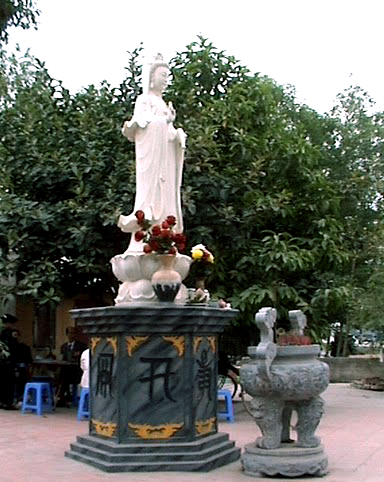
Hoa Khê Tự Pagoda
Bắc Ninh(formerly Bắc Giang)(Hoa Khê Tự)

Overview & history
Hoa Khê Tự is a pagoda located in Yên Khê hamlet, Tiền Phong ward, Bắc Ninh province (formerly also known as An Khê village, under Mỹ Cầu canton).
In 1805, King Gia Long established An Khê village as Yên Khê Commune. At that time, Yên Khê had 306 mẫu, 3 sào, 1 thước, and 5 tấc of land; of which public land accounted for 3 mẫu, 2 sào, and 3 thước; private land for 282 mẫu, 6 sào, 3 thước, and 8 tấc. In addition, there were also lands for the village deity, residential land, and ponds, etc.
History
Hoa Khê Tự was built in the 16th century. Hoa Khê Tự has endured through many centuries. When the French colonialists occupied the country, the pagoda was completely destroyed by the invaders. The original location of the pagoda was about 200 metres to the northwest of its current site.
In 1954, the resident monks and villagers transported some old timber from Cao Thượng, Tân Yên to build the pagoda at its present location. The land on which the pagoda now stands was donated by an official during the Lê Trung Hưng dynasty.
In 2002 (Year of the Horse), the people of Yên Khê hamlet and the resident monks rebuilt and restored the pagoda to its current form.
Within the pagoda grounds, there is a miếu (spirit shrine) dedicated to General Hoàng Tiến Chức. Inside the miếu, there remains an ancient four-sided stele. The inscription on the stele, carved during the Lê Trung Hưng dynasty, records the merits of Marquis Hoàng Tiến Chức, who donated some land to the people of Yên Khê hamlet, and lists the names of the village officials who received it.
Several rooms of the Hậu đường (rear hall) remain as they were in 1954.
On 11 October 2016 (the 11th day of the 9th lunar month, Year of the Dog), the resident monk Thích Đàm Văn passed away; the monk did not have any direct disciples.
In 2007, the local officials and villagers organised the restoration and construction of the pagoda gate and offered a statue of Avalokiteśvara Bodhisattva (Quan Thế Âm Bồ Tát). The head of the construction committee was village head Trần Văn Tuấn (Yên Khê). Party cell secretary: Trần Văn Yên.
Resident Monks
1. Monk: ...............................
2. Monk:
3. Bhikkhuni Superior THÍCH ĐÀM TÍNH – secular name Giáp Thị Bé. Born in 1921 in Yên Khê hamlet, Song Khê commune, Bắc Giang City. Passed away on 22/07/2015 (the 7th day of the 6th lunar month, Year of the Goat).
Lifespan: 95 years, monastic seniority: 87 years.
4. Bhikkhuni THÍCH ĐÀM VĂN – secular name LÊ ĐÀM VĂN, born in 1952 in Cao Viên, Thanh Oai, Hà Nội. Ordained at the age of 8. In 1968, followed Bhikkhuni Superior Thích Đàm Tính to Hoa Khê Tự to practise. Passed away on 11 October 2016 (the 11th day of the 9th lunar month, Year of the Dog). Lifespan: 65 years, monastic seniority: 49 years.
Currently, there is no resident monk.
Links
Chùa Trẻ
Photos
📷 Contribute photosVisiting tips
- Dress modestly; remove hats and keep quiet inside the main hall.
- Incense, flowers and offerings are usually sold right outside the gate; light an odd number of sticks (1 or 3).
- Most pagodas open from early morning to evening and are free to enter (some major sites charge a small scenic fee).
- Full-moon days, the 1st of the lunar month and Tet are very crowded; visit on weekday mornings for a quiet experience.
- Ask permission before photographing inside shrines; do not touch statues or altar objects.
Read more & references
Useful links to learn more before your visit:
Location
Coordinates: 21.24790, 106.16628
🧭 Directions on Google MapsReferences
- Vietnamese Wikipedia
- http://maps.google.com/maps/ms?msid=207844198041332425027.0004a8d26f766fdcbbbc6&msa=0/
- http://maps.google.com/maps/myplaces?ll=21.261701,106.181831&spn=0.010998,0.013797&sll=37.0625,-95.677068&sspn=23.875,57.630033&ctz=420&t=h&ppyss=confirm:0&z=16/
- https://picasaweb.google.com/110889233623852572415/GeoPhotos
- http://maps.google.com/maps?q=Y%C3%AAn+Kh%C3%AA,+Song+Kh%C3%AA,+tp.+B%E1%BA%AFc+Giang,+B%E1%BA%AFc+Giang,+Vi%E1%BB%87t+Nam+(y%C3%AAn+kh%C3%AA)&hl=vi&ie=UTF8&ll=21.259501,106.194277&spn=0.024397,0.027595&sll=37.0625,-95.677068&sspn=42.310334,56.513672&oq=y%C3%AAn+kh%C3%AA&hq=Y%C3%AAn+Kh%C3%AA,+Song+Kh%C3%AA,&hnear=tp.+B%E1%BA%AFc+Giang,+B%E1%BA%AFc+Giang,+Vi%E1%BB%87t+Nam&t=h&z=15&iwloc=D
- http://hannom.org.vn/trichyeu.asp?param=314&Catid=242
Other pagodas in Bắc Ninh