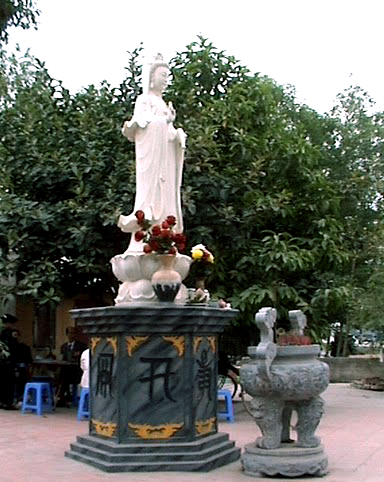
Kim Đài Pagoda
Bắc Ninh(Chùa Kim Đài)

Overview & history
Kim Đài Pagoda (also known as Đài Pagoda, Quỳnh Lâm Pagoda (Quỳnh Lâm tự), Lục Tổ Pagoda) is a pagoda located in Xuân Đài hamlet, Từ Sơn ward, Bắc Ninh province. According to legend, Lý Công Uẩn, the founder of the Lý dynasty of Vietnam, was once a novice monk at this pagoda during his childhood.
History
The pagoda was built in the 8th century. In the 9th century, Zen master Định Không expanded the pagoda, named it Quỳnh Lâm tự, and had a stone bell (khánh) carved. During the Lý dynasty, this was one of the largest and most beautiful pagodas, serving as a place of Buddhist worship for the Lý aristocracy. The stone bell of Quỳnh Lâm Pagoda was famous for its size. In the Trần dynasty, the pagoda was neglected and gradually deteriorated.
During the Ming invasion of Vietnam (1407–1427), the pagoda was severely destroyed. It was not until the Late Lê period, in the 22nd year of the Chính Hòa era (1701), that Princess Nguyễn Thị Ngọc Long, wife of Lord Trịnh Căn, had the pagoda rebuilt in its present spacious form. At that time, the pagoda had six statues of the six patriarchs (the first six abbots of the pagoda), so its name was changed to Lục Tổ Pagoda. In the Nguyễn dynasty, the pagoda was reduced in size. In 1952, French troops burned down the main hall (tam bảo) and the guest house of the pagoda. Today, the pagoda is a place of practice for Buddhist nuns.
Architecture
Within the pagoda are the Tam Bảo Hall (main Buddha hall), the ancestral hall, the Mother Goddess hall, and the rear sanctuary. In the ancestral hall are statues of the pagoda's patriarchs and an altar to Lady Nguyễn Thị Ngọc Long. The Tam Bảo Hall is dedicated to the Three Times Buddhas (Tam Thế), Shakyamuni (Thích Ca), Maitreya (Di Lặc), Amitabha (A-di-đà), and the Ten Kings of Hell (Thập Điện Diêm Vương). The pagoda also venerates Zen master Lý Khánh Văn and Lady Phạm Thị, mother of Lý Công Uẩn. The stupa of Lý Khánh Văn was newly reconstructed in 2000.
The pagoda covers about 2 mẫu (Vietnamese acres), with a pond, orchard, and rice fields. However, the rice fields and pond have been reclaimed by the commune authorities. The pagoda's space is also overshadowed by surrounding multi-storey residential buildings. The stupa of Lý Khánh Văn, which should be within the pagoda grounds, is now outside the pagoda.
During the pre-uprising period, the pagoda was a revolutionary base for Vietnamese Communist revolutionaries. During the First Indochina War, it served as a secret transit point for guerrilla forces and local soldiers.
Photos
📷 Contribute photosVisiting tips
- Dress modestly; remove hats and keep quiet inside the main hall.
- Incense, flowers and offerings are usually sold right outside the gate; light an odd number of sticks (1 or 3).
- Most pagodas open from early morning to evening and are free to enter (some major sites charge a small scenic fee).
- Full-moon days, the 1st of the lunar month and Tet are very crowded; visit on weekday mornings for a quiet experience.
- Ask permission before photographing inside shrines; do not touch statues or altar objects.
Read more & references
Useful links to learn more before your visit:
Location
Coordinates: 21.10816, 105.94776
🧭 Directions on Google MapsOther pagodas in Bắc Ninh