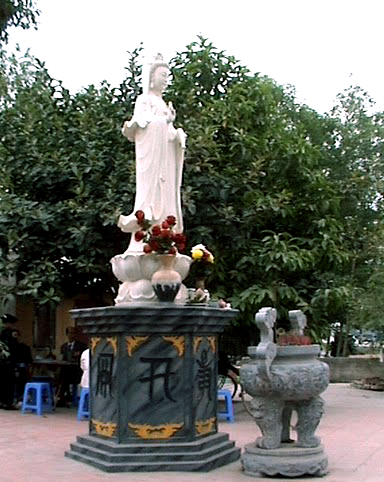
Cảm Ứng Pagoda
Bắc Ninh(Chùa Cảm Ứng)
Overview & history
Cảm Ứng Pagoda, also known as the Hundred-Bay Pagoda or Ứng Tự Pagoda, Tam Sơn Pagoda, is a historic pagoda located in Tam Sơn ward, in Bắc Ninh province.
History
Từ Sơn city is a land of culture and revolution, renowned as a region of scholarly achievement and devotion to learning, being one of the few villages to have produced all three top laureates (Trạng nguyên, Bảng nhãn, Thám hoa—collectively known as Tam khôi), and is also the homeland of revolutionary predecessor, the late Secretary of the Southern Region Party Committee, Ngô Gia Tự.
According to ancient records, from the pre-Lê period to the early Lý dynasty, Tam Sơn Pagoda (then called Ba Sơn Pagoda) was already one of the Buddhist centres of the Kinh Bắc region and the entire country. This is one of the oldest pagodas of Vietnamese Buddhism. The pagoda is built on Tam Sơn mountain. The three peaks rise like pearls above the plain. The name of the mountain is also the name of the village and commune, in Tiên Sơn district, Bắc Ninh. The pagoda predates the Lý dynasty. Around the early Lý period, monks Lã Định Hương (died 1050), Nghiêm Bảo Tsh (died 1034), and Phạm Minh Tâm (died 1050), of the 7th and 8th generations of the Vô Ngôn Thông Zen school, once resided and taught Buddhism here (according to the book Thiền uyển Tập Anh ngữ lục). The pagoda fell into ruin from the early 17th century. During the Lê Trung Hưng period, Lady Consort Nguyễn Thị Ngọc Vĩnh sponsored the restoration and expansion of the pagoda, building brick steps from the foot of the mountain up to the pagoda and erecting the bell tower in the year Quý Dậu (1693). In the year Đinh Sửu (1697), the stone pillar "Chúc Thiên đài" was erected to record the names of those who contributed to the pagoda's construction. In subsequent years, bells were cast and statues sculpted. The statues of the Thousand-Eyed Thousand-Armed Avalokiteśvara, Kim Đồng, Ngọc Nữ, Avalokiteśvara seated on the mountain, and the stone gong carved with dragons, phoenixes, and flowers are precious legacies of Vietnamese sculptural art from the late 17th century.
According to the "Việt sử lược" (Abridged History of Vietnam), during the Ứng Thiên era (955–1007), the pagoda was where Zen master Vạn Hạnh brought Lý Công Uẩn to take refuge from the pursuit of Lê Ngọa Triều. When the Lý dynasty was established, the pagoda remained the residence and place of practice for many patriarchs who contributed greatly to the building of the court and national culture under the Lý. Legend has it that in the past, when the pagoda still had all 100 bays, it was a gathering place for many rare sacred animals, such as turtles, dragons, and nghê (mythical lions).
In 1063, King Lý Thái Tôn had the pagoda rebuilt on a grand scale, turning it into a centre for training monks and a famous scenic site of the region. During the Lý dynasty, Princess Thuận Dương, Consort Thần Châu, and Consort Bảo Liên all practised at the pagoda. Today, traces of the Am Hoa Viên (flower garden) and statues of the princesses and consorts from the Lý period remain in the pagoda.
On the morning of the 1st day of Tết in the year Đinh Mùi (9 February 1967), President Hồ Chí Minh visited, spoke with officials, people, and children of Tam Sơn commune at the gate of Tam Sơn Pagoda. Afterwards, he planted a banyan tree in front of the pagoda gate, which still provides shade and is cherished and preserved by the local people.
During the resistance against the French, the Hundred-Bay Pagoda was a meeting place for revolutionary elements, a shelter for cadres, and a school for local children. In 1972, during the "Điện Biên Phủ in the air" campaign, the pagoda was bombed by American aircraft, causing many structures of Tam Sơn Pagoda to be damaged and Buddha statues to be burned. In 1975, and again in 2000, 2015, 2019, and 2020, the authorities and people of Tam Sơn village, together with the abbot Thích Đàm Chúc, restored and repaired the pagoda, reconstructing it to closely resemble its form before the American bombing.
Currently, the pagoda still preserves many Buddha statues and antiquities of historical and artistic value, such as: a stone gong carved in 1672, a stone incense pillar erected in 1679, a bronze bell cast in 1826, and especially the stele "Tam Sơn xã đăng hoa bi ký" erected in 1902...
The pagoda is one of the revolutionary historical sites attracting visitors, in combination with the Ngô Gia Tự relic complex.
Pagoda Festival
The Tam Sơn Pagoda Festival is a spiritual and community cultural activity, representing the concentrated and typical historical and cultural traditions of Tam Sơn village.
The festival takes place from the 8th to the 10th day of the first lunar month, and is the largest festival, carefully prepared and conducted with solemnity, grandeur, joy, and vibrancy.
In the past, the village had 6 hamlets divided into 3 thôn (village wards): thôn Tây, thôn Xanh (including xóm Xanh and xóm Ô), and thôn Lẻ (including xóm Đông, xóm Trước, and xóm Núi).
Preparation of offerings for the festival days is assigned by the village as follows:
- In the years of the Ox, Dragon, Goat, and Dog: on the 9th day thôn Lẻ prepares, on the 10th thôn Tây, and on the 11th thôn Xanh.
- In the years of the Tiger, Monkey, Snake, and Pig: on the 9th day thôn Xanh, on the 10th thôn Lẻ, and on the 11th thôn Tây.
The main offerings are buffalo meat, with one roasted buffalo each day carried in procession for the ritual. Later, this custom was abolished and replaced with oản (rice cakes) and chè lam (sticky rice cake). Each day, in turn, each thôn must prepare 9 vegetarian trays, each including 300 large oản, 100 pieces of chè lam, and a bottle of hoàng tửu (a special local wine of Tam Sơn village). The village allocates 11 mẫu (about 4 hectares) of rice fields to provide offerings for the annual festival days.
The sequence of the Tam Sơn Pagoda Festival is as follows: on the morning of the 9th, the person assigned to prepare the offerings, together with family and relatives, carries the trays to the Giỏ Communal House. The elders of the three thôn inspect the offerings, then divide them into 9 trays, placing them in a lacquered wooden box. The thôn's representative then leads the procession to the pagoda, accompanied by 100 flags, parasols, and musical instruments such as gongs and drums. At the forecourt, the thôn leader arranges the trays on the altars in the main hall, the East Temple, and the West Temple. Afterwards, the Tư văn (ritual master) conducts the offering ceremony. The ceremony is overseen by the chief cai đám (festival marshal) and two assistant cai đám. The cai đám (or festival official) must be 46 years old, of good standing, with both parents alive, many children, respected by the people, and selected by the village. The appointment of chief festival officials rotates among the thôn.
If a thôn appoints the chief festival official, the other two thôn provide the three chief celebrants for the three areas: East Temple, West Temple, and Main Hall, each with a ritual team accompanied by a bát âm (eight-instrument) ensemble, East and West choirs, and separate ritual recitations. The chief festival official must always be present at the West Temple. The three ritual teams rotate among the three areas:
- 9th day: thôn Lẻ in the Upper Hall, thôn Tây in the West Temple, thôn Xanh in the East Temple.
- 10th day: thôn Tây in the Upper Hall, thôn Xanh in the West Temple, thôn Lẻ in the East Temple.
- 11th day: thôn Xanh in the Upper Hall, thôn Lẻ in the West Temple, thôn Tây in the East Temple.
When the "lễ tất" (final ritual) is completed, the three main celebrants and the chief festival official rotate positions clockwise.
The 12th day is the closing ceremony for the Tư văn and village officials, presided over by the chief festival official and two assistants.
During the three main festival days, in addition to processions and rituals, the village organises many games for the people and visitors. At the water puppet pond, troupes from various places perform water puppetry, and there are singing exchanges between the Tam Sơn quan họ troupes and their partner troupes from Lũng Giang (Lim). These are two original quan họ villages with a long-standing friendship. Many games such as cockfighting, human chess, and swinging attract large crowds. A highlight is the earthen pot-breaking game at An Hòa Viên. Here, two horizontal bars are erected about 3m high and 2.5m wide. An earthen pot containing rice husks and water is hung from a red-dyed bamboo pole tied to the bar. The pot hangs about 40cm from the bar, and from the starting point, about 10m away, the player is blindfolded with a red scarf about 1.2–1.5m long. Approaching the bar, the player may use a bamboo stick to feel for the pot and then strike. If the pot is broken, the player wins. The prize is only 3 oản cakes and a few squares of silk, but the whole village believes that year will bring a bumper harvest and prosperity. This is a symbolic echo of the custom of worshipping rice husks and splashing water at the start of the year, a belief of wet-rice agricultural communities in the Red River Delta.
If the harvest is good, the village also organises a female official procession. On this occasion, wealthy families often donate to the village to organise the procession on a large scale, mobilising hundreds of people to participate in the rituals and processions.
Photos
📷 Contribute photosVisiting tips
- Dress modestly; remove hats and keep quiet inside the main hall.
- Incense, flowers and offerings are usually sold right outside the gate; light an odd number of sticks (1 or 3).
- Most pagodas open from early morning to evening and are free to enter (some major sites charge a small scenic fee).
- Full-moon days, the 1st of the lunar month and Tet are very crowded; visit on weekday mornings for a quiet experience.
- Ask permission before photographing inside shrines; do not touch statues or altar objects.
Read more & references
Useful links to learn more before your visit:
Location
Coordinates: 21.14459, 105.97455
🧭 Directions on Google MapsReferences
Other pagodas in Bắc Ninh