Quỳnh Lâm Pagoda
Quảng Ninh(Chùa Quỳnh Lâm)
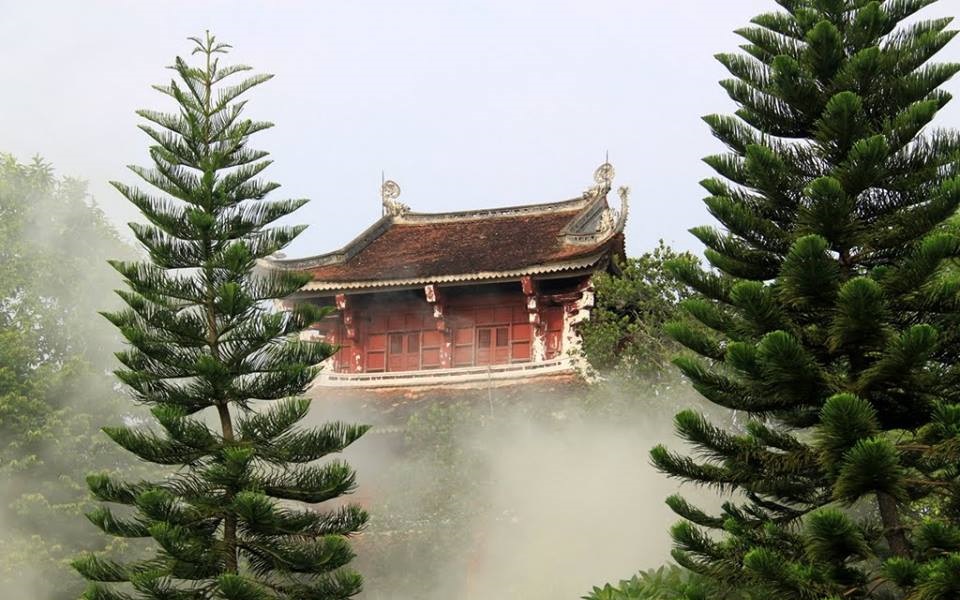
Overview & history
Quỳnh Lâm Pagoda (Chinese characters: 瓊林寺, Sino-Vietnamese pronunciation: Quỳnh Lâm tự) is a famous ancient pagoda in Quảng Ninh, located within the Trần Dynasty Relic Area in Đông Triều.
Location
Quỳnh Lâm Pagoda is situated on a hill in the Đông Triều arc, in Tràng An ward, Đông Triều city, Quảng Ninh province, 83 km from Hạ Long city. The pagoda has been recognised by the Ministry of Culture and Information as a historical and artistic relic.
The pagoda lies at the centre of three areas: Upper, Lower, and Sinh. In front of the pagoda is a large lake, while the other three sides are surrounded by hills and mountains. This terrain is called the throne position, or the "Dragon bowing, Tiger crouching" configuration.
History
According to researchers and historical documents, including the pagoda's own stele, Quỳnh Lâm Pagoda was built during the reign of King Lý Thần Tông (1116-1138). The person who made great contributions to the construction of the pagoda was the national teacher Nguyễn Minh Không (1076-1141). From the 11th to 14th centuries, during the late Lê period and the 17th-18th centuries, Quỳnh Lâm was the largest Buddhist centre in Vietnam.
During the Lý dynasty, the monk Minh Không cast a bronze Maitreya statue six trượng (about 20 m) high, once considered one of the Four Great Treasures of An Nam, and a large stone stele 2.5 m high and 1.5 m wide, decorated with soft, winding dragon motifs. However, Quỳnh Lâm Pagoda truly became an important Buddhist centre in the 14th century with the activities of Pháp Loa Đồng Kiên Cương, the second patriarch of the Trúc Lâm Zen sect.
On the foundation of the old Quỳnh Lâm Pagoda, in December 1317, Pháp Loa built and established the Quỳnh Lâm Institute with grand and complete architecture. With strong support from the king and the nobility, Pháp Loa built and expanded many pagodas and stupas. In 1314 alone, he built 33 Buddhist shrines, scripture repositories, and more. During this period, on the basis of the old Quỳnh Lâm Pagoda, in 1316 Pháp Loa established the Quỳnh Lâm Institute—the first Buddhist university in our country. In the late 13th and early 14th centuries, along with Hoa Yên Pagoda in Yên Tử, Báo Ân Pagoda in Siêu Loại (Bắc Ninh), and Thanh Mai Pagoda in Hải Dương, the Quỳnh Lâm Zen Monastery under Pháp Loa's abbotship was one of the Trúc Lâm sect's religious centres during the Trần dynasty. In 1329, Quỳnh Lâm became the foremost famous scenic and historical site of Đại Việt. It was a centre for teaching scriptures, preaching, and training Buddhist monks. Many major festivals recorded in history were held here, such as the "Thousand Buddhas for seven days and seven nights" festival (1325). Legend has it that the institute could accommodate up to three thousand people at once. There was also the Bích Động hermitage for meditation. A prince-in-law of the Vũ family during the Trần dynasty donated 20 mẫu (about 7 hectares) of rice fields. Minister Văn Huệ Vương Trần Quang Triều and Princess Thượng Trân donated 900 taels of gold to cast the Maitreya statue. The pagoda owned over a thousand mẫu of rice fields, with thousands of tenant farmers.
In 1319, Pháp Loa called on monks and Buddhists to draw blood to print over 5,000 volumes of the Tripitaka, which were kept at the Quỳnh Lâm Institute. Pháp Loa also had many sets of Buddhist scriptures carved at Vĩnh Nghiêm Pagoda to serve the propagation and circulation of Buddhist teachings. Later, the Ming dynasty's "book destruction" policy led to the destruction of woodblocks in the early 15th century. The scriptures at Vĩnh Nghiêm Pagoda were more fortunate and have survived to this day. In 1328, he again cast a Maitreya statue. He then petitioned the king to allow the statue to be moved from the main hall to the throne for gilding. In 1329, Pháp Loa brought part of the ashes of Trần Nhân Tông, the first patriarch of the Trúc Lâm Zen sect, to be placed in a stone stupa at Quỳnh Lâm.
Relics
When the Ming invaders attacked Đại Việt (1407), the pagoda was severely destroyed, and the Quỳnh Lâm Buddha statue was taken to Jinling (Nanjing). In the early Lê dynasty, the pagoda was rebuilt.
During the Vĩnh Khánh era (1729-1732), Uy Nam Vương Trịnh Giang provided funds and mobilised people from the three districts of Đông Triều, Thủy Đường, and Chí Linh to restore and lavishly decorate the pagoda. At the beginning of the Vĩnh Hựu era (1735-1746), people from the districts of Hiệp Sơn, Thủy Đường, Đông Triều, Kim Thành, and Thanh Hà were again mobilised for further renovations, making the pagoda even larger, with bronze bells and stone gongs.
In 1727, the Tịch Quang Stupa was built from blue stone. This stupa is the tomb of the monk Chân Nguyên, who made great contributions to the pagoda. The stupa has seven storeys, is 10 m high, with a bodhi-bud-shaped top, and bears a stele recording the biography of Chân Nguyên. In the Nguyễn dynasty, in the sixth year of Thiệu Trị (1845), Chinese bandits burned down the main hall and front hall of the pagoda. All the wooden statues were destroyed by fire, except for the statue of King Trần Nhân Tông, which remained intact. Through the vicissitudes of history, most of Quỳnh Lâm Pagoda's ancient architectural works have been destroyed.
According to the preliminary report on the results of investigation and archaeological excavation and research at Quỳnh Lâm Pagoda and Ngọa Vân (2009) by the Institute of Archaeology – Vietnam Academy of Social Sciences, in 2007, the People's Committee of Đông Triều district and the Institute of Archaeology implemented Phase I of the archaeological investigation and excavation project at Quỳnh Lâm Pagoda, and in 2008, continued with Phase II. In 2009, Phase III of excavation and research was carried out. Through three excavation phases, the entire foundation of the Lê Trung Hưng period architecture and some Nguyễn dynasty structures have been clearly revealed. The foundations of nine architectural works and six courtyards were found, interconnected to form a complex of various architectural types. Interspersed among the Tiền Đường (Front Hall), Trung Đường (Middle Hall), and Hậu Đường (Rear Hall) structures are corridors and six rectangular courtyards, built of blue stone, symmetrically arranged both lengthwise and crosswise, creating a harmonious space for the buildings.
The survey results also show that archaeologists have recorded 29 stupa foundations dating from the 18th to the early 20th century. The earliest stupa is the Tuệ Đăng Stupa of Zen master Chân Nguyên, which is also the best-preserved stupa in the stupa garden. Notably, the 2009 survey also found some components of a stone stupa from the Trần dynasty, built by Zen master Pháp Loa to house the relics of Tĩnh tuệ Giác hoàng Trần Nhân Tông. However, the search for information related to important stupas built at Quỳnh Lâm has so far only found stupa components, with no traces of stupa foundations yet discovered.
Besides the archaeological investigations and excavations at Quỳnh Lâm Pagoda since 2007, which have revealed the grand scale of the ancient pagoda's architecture, some ancient artefacts are still preserved at the pagoda today. These include a 2.5 m high stone stele in front of the pagoda, decorated with soft, winding dragon motifs characteristic of Lý dynasty dragons; blue stone dragon-step balustrades; nearly one hundred stone column bases carved with lotus petals; terracotta dragon heads; and stone gongs. Especially notable is a corner of a stone pedestal featuring the Garuda divine bird, shaped like a squatting human figure with arms raised to support the lotus throne. All these clearly display the stone carving style of the Trần dynasty.
From the Lê dynasty, the most numerous remaining artefacts are stone steles and stupas, especially two stone reliefs on the ancestral tablet and statue of Lady Hậu Phật Bùi Thị Thao, with elaborately, meticulously, and softly carved motifs in dynamic, natural, and realistic poses. The pagoda also has stone steles recording the exact dates of renovations, the names of male and female devotees who generously contributed money for repairs, and the works carried out during each restoration. In the pagoda garden, there is also a system of ancient stupas assembled from fine-grained blue stone, using mortise-and-tenon techniques, leaving an invaluable artistic heritage for posterity.
Festival
The Quỳnh Lâm Pagoda festival takes place from the 1st to the 4th day of the 2nd lunar month, but spring visitors come to the pagoda throughout the three spring months, with the sincere devotion of all Buddhist followers from near and far who come here to offer incense and worship the Buddha.
Photos
📷 Contribute photosVisiting tips
- Dress modestly; remove hats and keep quiet inside the main hall.
- Incense, flowers and offerings are usually sold right outside the gate; light an odd number of sticks (1 or 3).
- Most pagodas open from early morning to evening and are free to enter (some major sites charge a small scenic fee).
- Full-moon days, the 1st of the lunar month and Tet are very crowded; visit on weekday mornings for a quiet experience.
- Ask permission before photographing inside shrines; do not touch statues or altar objects.
Read more & references
Useful links to learn more before your visit:
References
- Vietnamese Wikipedia
- http://quangninh.gov.vn/vi-VN/so/sovanhoathethaodl/Trang/Chitietditichdanhthang.aspx?maso=28
- http://www.quangninh.gov.vn/vi-VN/So/sovanhoathethaodl/Trang/Chitiettraodoinghiepvu.aspx?maso=37
- http://www.baoquangninh.com.vn/van-hoa/201304/Chua-Quynh-Lam-2193212/
- http://www.wapviet.vn/truyendai/article-10634/hoi-45.html?page=21
- https://web.archive.org/web/20131228134954/http://www.baoquangninh.com.vn/van-hoa/201304/Chua-Quynh-Lam-2193212/
- https://web.archive.org/web/20150123141424/http://www.quangninh.gov.vn/vi-VN/So/sovanhoathethaodl/Trang/Chitiettraodoinghiepvu.aspx?maso=37
- https://web.archive.org/web/20150924083805/http://www.quangninh.gov.vn/vi-VN/so/sovanhoathethaodl/Trang/Chitietditichdanhthang.aspx?maso=28
Other pagodas in Quảng Ninh


