Keo Pagoda Hành Thiện
Ninh Bình(formerly Nam Định)(Chùa Keo Hành Thiện)
Overview & history
Keo Pagoda (formal name: Thần Quang tự 神 光 寺) is a pagoda located in Hành Thiện village, Xuân Hồng commune, Ninh Bình province, Vietnam. From Hoa Lư ward, the centre of Ninh Bình province, it is 57 km to the pagoda. This is one of the ancient pagodas in Vietnam that has been preserved with almost intact 400-year-old architecture. The pagoda has been classified as a special national relic since 2016.
Origin
According to legend, the original pagoda was built by Zen master Không Lộ on the banks of the Red River in 1061 during the reign of Lý Thánh Tông, at Giao Thủy hamlet, Hải Thanh prefecture.
Initially, the pagoda was named Nghiêm Quang tự, and in 1167 it was renamed Thần Quang tự. Because Giao Thủy had the vernacular name Keo, this pagoda was also called Keo Pagoda. The Zen master who founded the pagoda was Dương Không Lộ, originally from Giao Thủy village, Hải Thanh prefecture, with his mother’s hometown being Hán Lý village, Ninh Giang prefecture, Hải Dương province. Không Lộ, Giác Hải, and Đạo Hạnh were three Zen masters and national teachers during the Lý dynasty, who became sworn brothers and travelled to India (Tây Trúc) to study Buddhism together.
After nearly 500 years of existence, in 1611, the Red River rose and eroded Giao Thủy village, where the pagoda was located. A portion of the population moved south of the Red River, to Hành Cung hamlet (renamed Hành Thiện village during the Nguyễn dynasty), and built the new Keo Pagoda, commonly called Keo Dưới (Lower Keo) or Keo Hành Thiện Pagoda (now in Xuân Hồng commune, Ninh Bình). Another portion of the population moved to the left bank of the Red River, established Dũng Nhuệ village on Vũ Tiên land, Hưng Yên province, and later also built a pagoda, called Keo Pagoda Thái Bình or Keo Trên (Upper Keo), Keo Thượng.
Architecture
Initially, the pagoda was temporarily built on the village land. In the 13th year of Hoằng Định (1612), the pagoda was fully restored and took on its present appearance. Over the next 400 years, the pagoda underwent several major renovations, such as in the 9th year of Cảnh Trị (1671), the 25th year of Chính Hoà (1704), the 7th year of Thành Thái (1896), and especially since 1962, when Keo Pagoda was recognised by the state as a historical and cultural relic, it has been restored many times.
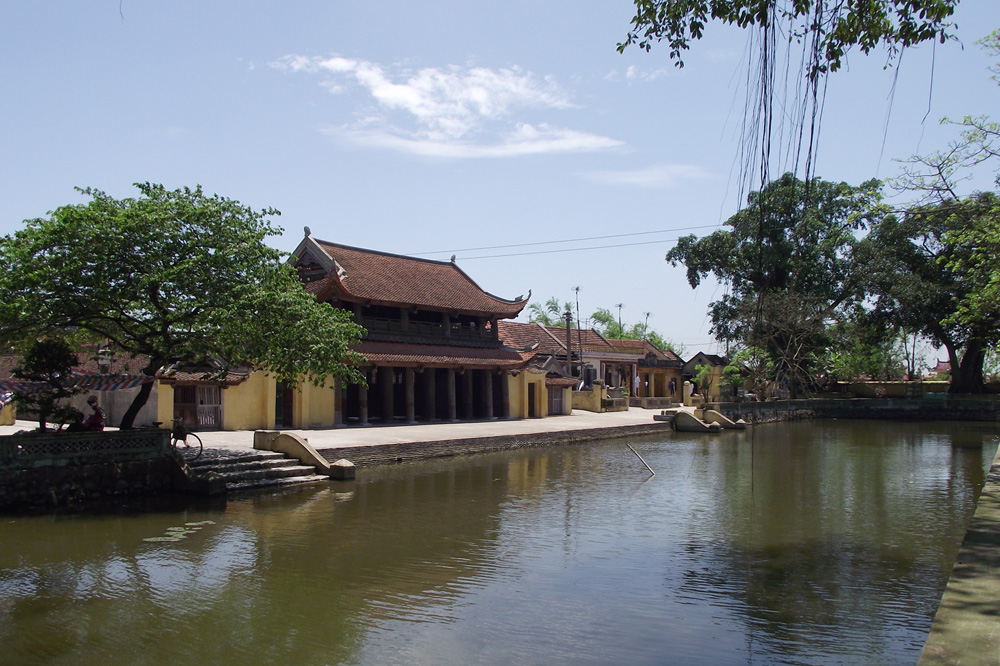
Built earlier, the architecture of Keo Hành Thiện Pagoda greatly influenced Keo Pagoda in Thái Bình. In front of the pagoda is a crescent-shaped pond with clear blue water, reflecting the solemn, poetic bell tower with its curved roof. The pagoda complex is a vast, grand ancient architectural area with 13 large buildings comprising 121 interconnected compartments, their reflections shimmering on the magical pond. On both sides of the brick-paved kiệu path are two adjacent corridors, each with 40 imposing compartments.
Although it does not have the massive three-storey, twelve-roofed bell tower like Keo Pagoda in Thái Bình, the bell tower of Keo Hành Thiện Pagoda is also a harmonious combination of a five-compartment inner triple-gate (tam quan nội), built in the chồng diêm (overlapping storeys) style, 7.5 metres high. Its elegant appearance features curved roofs and gracefully arched bảy (supporting beams). Below are 8 main pillars and 16 secondary columns placed on stone bases carved with blooming lotus petal motifs.
In addition to its architectural beauty, the pagoda also preserves valuable ancient artefacts from the 17th century, Hậu Lê period. These include bookcases, altars, Dharma statues, many bells and khánh (large flat gongs), ancient steles, horizontal lacquered boards, parallel sentences, and Han-script books about Keo Pagoda. Behind the pagoda is the Thánh Temple (đền Thánh), dedicated to the Holy Ancestor, Great Dharma Zen Master Không Lộ, who cured King Lý Nhân Tông.
Festival
The Keo Hành Thiện Pagoda Festival takes place from the 10th to the end of the 16th day of the 9th lunar month every year. Several days before the festival opens, all villagers participate in cleaning the village roads and alleys, hanging the great flags of the various neighbourhoods at both ends of the hamlets and along the main Thổ lối road. The neighbourhoods launch their racing boats on the festival’s opening day or a few days prior, so the village youths can practise rowing. From early morning on the opening day, the great bells, khánh and drums resound in long peals throughout the village. After the nhập tịch (registration) ceremony and opening of the pagoda, the village holds the Buddha-inviting ceremony, the Saint-offering ceremony, incense offering, and the flag-raising to open the festival. After the opening ceremony, members of the Festival Organising Committee and the Festival Steering Committee, together with commune and district guests, proceed to the Memorial House of the late General Secretary Trường Chinh to offer incense in his honour. After the rituals, there are cultural, sporting, and recreational activities around the pagoda.
A special feature of the Keo Pagoda Festival is the Boat Racing event, one of the most traditional and unique competitions (unlike any other festival competition in Vietnam). This event involves 10 people on a boat, which the people of Hành Thiện village call a "trải". The difference is that the Trải Rowing is done standing (like punting), with 9 rowers and 1 helmsman, and there are 15 such boats. The race is held on the two main festival days: the 12th and 15th of the 9th lunar month. Alongside the Trải Rowing is the Phụng Nghinh ceremony, one of the most important rituals of the festival.
Photos
📷 Contribute photosVisiting tips
- Dress modestly; remove hats and keep quiet inside the main hall.
- Incense, flowers and offerings are usually sold right outside the gate; light an odd number of sticks (1 or 3).
- Most pagodas open from early morning to evening and are free to enter (some major sites charge a small scenic fee).
- Full-moon days, the 1st of the lunar month and Tet are very crowded; visit on weekday mornings for a quiet experience.
- Ask permission before photographing inside shrines; do not touch statues or altar objects.
Read more & references
Useful links to learn more before your visit:
Location
Coordinates: 20.34222, 106.32167
🧭 Directions on Google MapsReferences
- Vietnamese Wikipedia
- https://xuantruong.namdinh.gov.vn/di-tich-lich-su-van-hoa/di-tich-quoc-gia-dac-biet-chua-keo-hanh-thien-288516
- https://laodong.vn/photo/kien-truc-dieu-khac-doc-dao-cua-ngoi-chua-gan-1000-nam-tuoi-o-nam-dinh-1314036.ldo
- https://namdinh.org.vn/diem-den-nam-dinh/le-hoi-chua-keo-hanh-thien-di-san-van-hoa-phi-vat-the-quoc-gia-387861
- https://tools.wmflabs.org/geohack/geohack.php?language=vi&pagename=Ch%C3%B9a_Keo_H%C3%A0nh_Thi%E1%BB%87n¶ms=20_20_32_N_106_19_18_E_type:landmark
- https://web.archive.org/web/20240101122238/https://xuantruong.namdinh.gov.vn/di-tich-lich-su-van-hoa/di-tich-quoc-gia-dac-biet-chua-keo-hanh-thien-288516
Other pagodas in Ninh Bình
