Keo Pagoda (Hà Nội)
Hà Nội(Chùa Keo (Hà Nội))
Overview & history
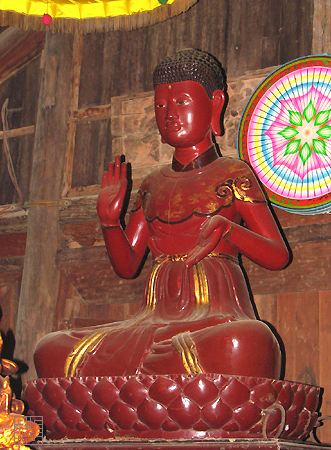
Keo Pagoda in Hà Nội, with the formal name Báo Ân Trùng Nghiêm Tự, is located in Chè village, Kim Sơn commune, Gia Lâm district, Hà Nội. The pagoda venerates Lady Keo, also known as Lady Pháp Vân, who is one of the Four Great Dharma Goddesses (Tứ Pháp) of ancient Vietnamese Buddhism.
Lady Keo
The legend of Lady Keo is associated with the legend of the Buddhist Mother Man Nương and the Four Dharmas (Tứ Pháp) in the Dâu Luy Lâu region.
According to tradition, when Sĩ Nhiếp had four statues carved—Pháp Vân, Pháp Vũ, Pháp Lôi, and Pháp Điện—there was a small leftover piece of wood from the tip. The sculptor, surnamed Đào, used it to carve a smaller statue of Pháp Vân. The original statues were distributed to the pagodas in the Luy Lâu area and were given vernacular names after the villages: Lady Dâu, Lady Đậu, Lady Tướng, Lady Dàn. The smallest statue was brought to Keo village for worship and called Lady Keo.
Although Lady Keo is an incarnation of the eldest sister Pháp Vân, she is considered the youngest of the Four Dharmas. It is said that in the past, Lady Keo was also brought to attend the Dâu festival on the 8th day of the 4th lunar month like her sisters. However, she was the most mischievous; once, during the procession, her palanquin dropped her crown into a pile of buffalo dung, so the elders of Tổng Dâu decided not to let her enter anymore. Since then, Lady Keo only pays homage from afar to the area of Dâu to worship the Buddhist Mother, but does not enter Dâu Pagoda to join the communal gathering with the Four Dharmas as before.
History of the Pagoda
Keo Pagoda belongs to Giao Tự hamlet, also known as Chè village. In the past, both Chè village (Giao Tự) and Keo village (Giao Tất) shared the same pagoda, hence the name Keo Pagoda.
The pagoda is situated on an area of over 10,000 square metres, designed in the traditional 'nội công ngoại quốc' (inner I-shaped, outer square) architectural style. In front is the Thiên Lý road (now road 181), and behind is the Thiên Đức river (now the Đuống river). The pagoda still retains its ancient appearance and is one of Hà Nội's old pagodas.
The name Keo originates from the meaning that the two hamlets, Giao Tự and Giao Tất, are as closely bonded as 'Keo Sơn' (a Vietnamese expression for strong unity). Chè village belongs to Kim Sơn commune, Gia Lâm district, Hà Nội.
The pagoda houses a total of 47 Buddha statues, many of which bear the artistic style of the 17th–18th centuries. Among them, the statue of Lady Keo is an 18th-century artwork.
The pagoda still preserves six stone steles, including one from the 16th year of Hoằng Định (1615), a bell cast during the Cảnh Thịnh era (1794), a bronze gong, eight imperial decrees, and many worship objects and carved panels in the artistic style of the Lê dynasty.
The pagoda has undergone many restorations, with major renovations recorded on the steles from 1611, 1638, 1787, etc. During the resistance against the French, the pagoda was heavily damaged by bombs and shells, so it underwent major restoration in 1933.
In 1993, the pagoda was recognised as a historical and cultural relic.
Festival
The festival of Keo Pagoda in Kim Sơn commune, Gia Lâm district, Hà Nội city is held annually on the 6th day of the 4th lunar month.
Photos
📷 Contribute photosVisiting tips
- Dress modestly; remove hats and keep quiet inside the main hall.
- Incense, flowers and offerings are usually sold right outside the gate; light an odd number of sticks (1 or 3).
- Most pagodas open from early morning to evening and are free to enter (some major sites charge a small scenic fee).
- Full-moon days, the 1st of the lunar month and Tet are very crowded; visit on weekday mornings for a quiet experience.
- Ask permission before photographing inside shrines; do not touch statues or altar objects.
Read more & references
Useful links to learn more before your visit:
Location
Coordinates: 21.02667, 105.99111
🧭 Directions on Google MapsReferences
Other pagodas in Hà Nội


