Từ Hiếu Pagoda
Huế(Chùa Từ Hiếu)
Overview & history
Từ Hiếu Pagoda, also known as Từ Hiếu Ancestral Pagoda (Chữ Hán: 慈孝寺, Từ Hiếu Tự), is the name of a pagoda located in Dương Xuân Thượng III village, Thủy Xuân ward, Huế city. The pagoda is one of the major ancient temples and a cultural and historical landmark of the former imperial capital of Huế.
History
In 1843, after resigning from the position of "Tăng Cang Giác Hoàng Quốc Tự" and handing over the management of Bảo Quốc Pagoda to his dharma brother Nhất Niệm, Venerable Nhất Định came here to found the temple, establishing the "Thảo Am An Dưỡng" (Hermitage of Peaceful Nourishment) for meditation and to care for his elderly mother.
Venerable Nhất Định was renowned for his filial piety. It is said that once, when his mother was gravely ill, he took care of her daily with medicine, but she did not recover. Someone, out of concern, advised him to buy more meat and fish to nourish her, saying only by doing so could she regain her strength. Upon hearing this, despite public gossip and criticism, the Zen master still walked with his staff through the forest, travelling over 5 km to the market to buy fish to cook porridge for his mother. The story reached Emperor Tự Đức, who was himself very filial to his mother. The emperor was deeply moved by Nhất Định's devotion and bestowed upon the temple the title "Sắc tứ Từ Hiếu tự" (Imperially Bestowed Từ Hiếu Pagoda). From then on, the pagoda bore the name Từ Hiếu. The stele recording the construction process of the pagoda explains:
Từ (Compassion): is the great virtue of the Buddha; without compassion, how could one save sentient beings and help all living things?
Hiếu (Filial Piety): is the foremost practice of the Buddha; without filial piety, how could one attain the wondrous unity that pervades heaven and earth?
With the contributions of lay Buddhists and substantial funding from Emperor Tự Đức, the pagoda also received donations from officials of the Nguyễn court, especially the eunuchs, to support future worship. In 1848, Venerable Cương Kỷ began to construct the pagoda on a larger scale, and Từ Hiếu became a major temple.
In 1894, Venerable Cương Kỷ continued to renovate and rebuild the entire pagoda with the help of Emperor Thành Thái, court officials, and Buddhists.
In 1931, Venerable Huệ Minh continued the renovations and built the semicircular pond.
In 1962, Venerable Chơn Thiệt continued to renovate and refurbish the entire pagoda.
In 1971, the pagoda was further restored by Venerable Chí Niệm, who renovated the Tam Quan gate, the semicircular pond, and other damaged buildings.
Architecture
Từ Hiếu Pagoda is an ancient temple, nestled in a pine forest on a hilly (mountainous) area of Thủy Xuân ward. The temple grounds cover about 8 mẫu (approximately 2.88 hectares), with a winding stream in front, creating a poetic landscape.
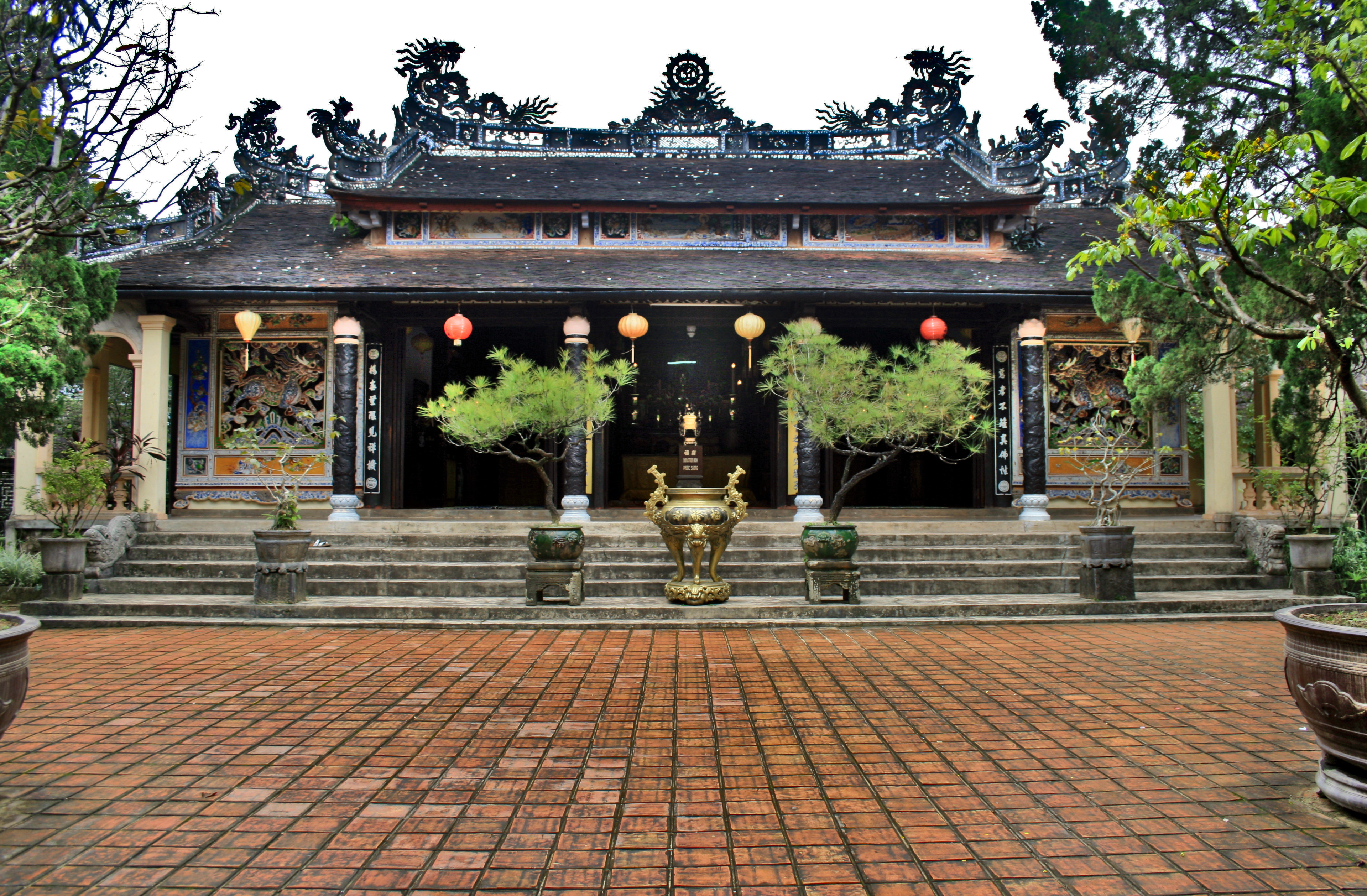
In front of the pagoda gate stands a three-storey tower built in 1896, used to store scriptures and statues by royal decree. The gate is built in an arched style, with two tiers and a roof. Right before the brick-paved path leading to the main hall is a semicircular pond planted with lotuses and stocked with ornamental fish (such as catfish, etc.). The pagoda's structure follows the style of three main compartments and two side wings; at the front is the main hall worshipping the Buddha, and at the back is Quảng Hiếu Hall. In the rear building is an altar to Tả quân đô thống Lê Văn Duyệt, along with his wooden horse and great sabre. On either side of the temple courtyard are two stele pavilions recording the history of the pagoda's construction. The pagoda is built in the style of a main hall with three compartments and two side wings, with the front dedicated to the Buddha and the rear to the Ancestral Masters. The rear building is Quảng Hiếu Hall, with the central altar dedicated to the Holy Official, the left side to the spirits of lay Buddhists, and the right side to the eunuchs. On the left of the rear courtyard is Tả Lạc Thiên (the monks' quarters), and on the right is Hữu Ái Nhật (the guest house).
Surrounding Từ Hiếu Pagoda are many tombs of the concubines of the Nguyễn lords. Due to its beautiful, tranquil location not far from Huế city, this place is a popular spot for Huế youth to picnic on holidays and weekends. Từ Hiếu Pagoda is one of the ancient temples in the former imperial capital that welcomes the largest number of domestic and international tourists.
Abbots
Từ Hiếu Ancestral Pagoda was founded by the former "Tăng Cang Giác Hoàng Quốc Tự", that is, Venerable Nhất Định. The pagoda has had the following generations of abbots:
Venerable Cương Kỷ.
Venerable Huệ Đăng.
Venerable Tâm Tịnh.
Venerable Huệ Minh.
Venerable Chơn Thiệt.
Venerable Chí Niệm.
Venerable Chí Mậu.
Zen Master Nhất Hạnh (with Venerable Từ Đạo as resident supervisor). [2]
Activities and Achievements
In 1848, the pagoda held its inauguration ceremony, attended by Emperor Dực Tông, Lady Từ Dũ, and high-ranking officials.
In 1924, the pagoda organised the Great Ordination Ceremony (Đại Giới Đàn) attended by Emperor Khải Định, with Venerable Tâm Tịnh as the preceptor and Venerable Huệ Minh as the master of ceremonies. Venerables Mật Khế, Viên Quan, Bích Phong, and Đôn Hậu were among the monks ordained at this ceremony.
In 1965, the Vạn Hạnh Great Ordination Ceremony was held here.
Through successive generations of abbots, the pagoda has re-carved and printed scriptures such as: Phật Thuyết Báo Ân Phụng Bồn Kinh (The Buddha's Teaching on Repaying Kindness), Cao Vương Quán Thế Âm Kinh, Thiền Môn Nhật Tụng (Daily Chants of the Zen Monastery), Đại Thừa Vô Lượng Nghĩa Kinh (Mahāyāna Infinite Meaning Sutra), Pháp Bảo Đàn Kinh (Platform Sutra), and the Ritual for Rebirth in the Pure Land, among others.
The pagoda has also directly or indirectly fostered many renowned monks and Zen masters, such as: Diệu Giác, Hải Thiệu, Tâm Tịnh, Huệ Minh, Huệ Pháp, Huệ Giác, Viên Giác, Viên Thành, Chơn Thiệt, Chơn Như, and others.
Photos
📷 Contribute photosVisiting tips
- Dress modestly; remove hats and keep quiet inside the main hall.
- Incense, flowers and offerings are usually sold right outside the gate; light an odd number of sticks (1 or 3).
- Most pagodas open from early morning to evening and are free to enter (some major sites charge a small scenic fee).
- Full-moon days, the 1st of the lunar month and Tet are very crowded; visit on weekday mornings for a quiet experience.
- Ask permission before photographing inside shrines; do not touch statues or altar objects.
Read more & references
Useful links to learn more before your visit:
Location
Coordinates: 16.43855, 107.57299
🧭 Directions on Google MapsReferences
- Vietnamese Wikipedia
- http://www.thuvienhoasen.org/cvn-hue-tuhieu.htm
- http://www3.thuathienhue.gov.vn/GeographyBook/Default.aspx?sel=3&id=151
- https://www.facebook.com/pg/chuatuhieuhue/about/?ref=page_internal
- https://web.archive.org/web/20140410101811/http://www3.thuathienhue.gov.vn/GeographyBook/Default.aspx?sel=3&id=151
- https://web.archive.org/web/20071115142819/http://www.thuvienhoasen.org/cvn-hue-tuhieu.htm
- https://www.facebook.com/https://www.facebook.com/chuatuhieuhue/
Other pagodas in Huế


