Sà Lôn Pagoda
Cần Thơ(formerly Sóc Trăng)(Chùa Sà Lôn)
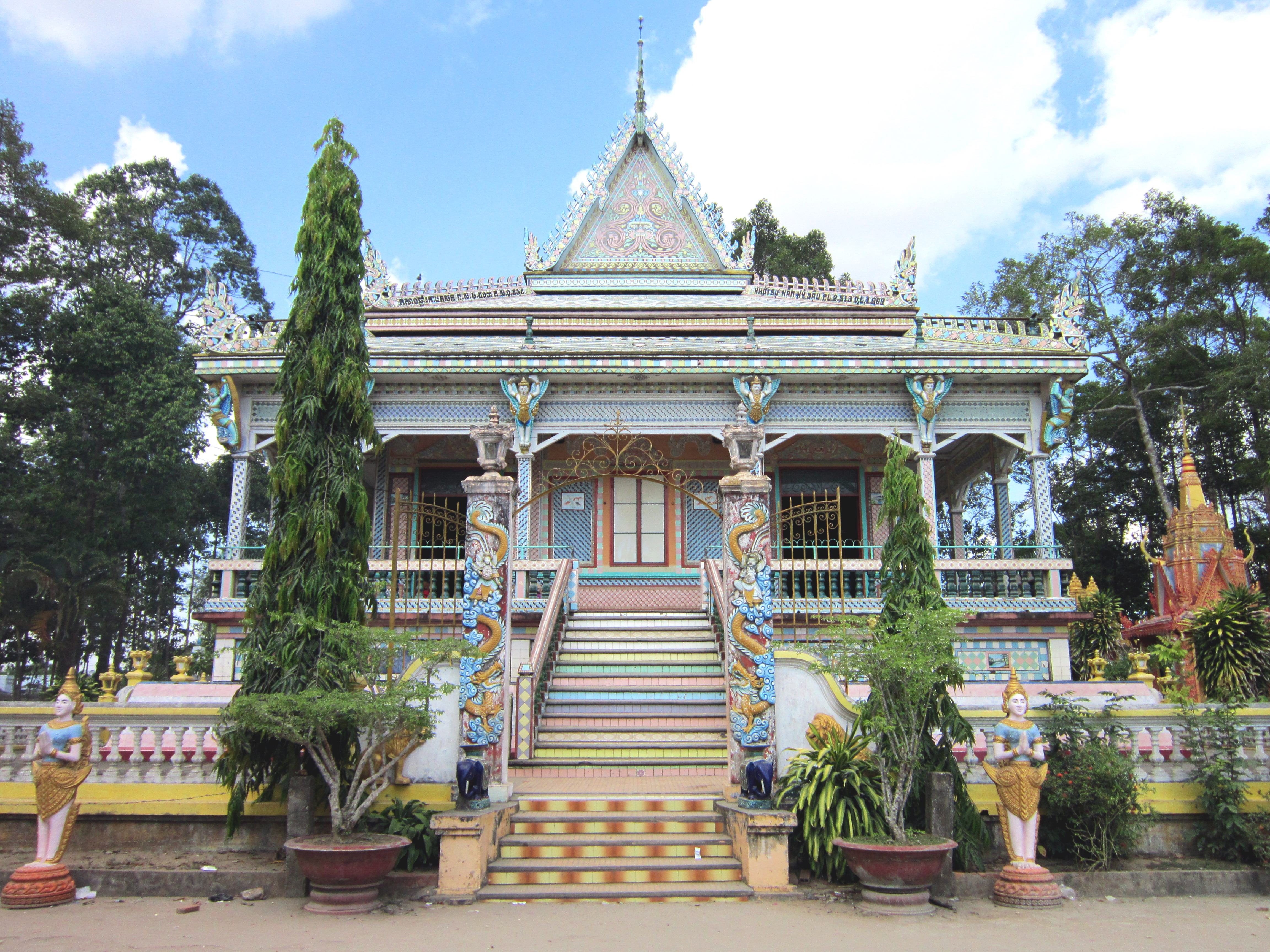
Overview & history
Sà Lôn Pagoda (in Khmer: វត្តស្រឡូង, or Wath Chro Luông, commonly known as Chén Kiểu Pagoda) is an ancient pagoda belonging to the Khmer Theravāda Buddhist tradition.
Location
Sà Lôn Pagoda is located on National Highway 1, in the Tâm Lộc area, Mỹ Xuyên ward, Cần Thơ city, Vietnam.
Name
The pagoda's Khmer name is "Wath Sro Loun"; for ease of pronunciation, "Sro Loun" is pronounced as "Sà Lôn". "Sro Loun" itself originates from the word "Chro Luong", which is the name of a canal that used to run along the village road near the pagoda, and this name was also used for the pagoda. The reason Sà Lôn Pagoda is also called "Chén Kiểu Pagoda" (Pagoda of Patterned Bowls) is because fragments of porcelain bowls and plates are used to decorate its walls.
Origin
According to legend, Sà Lôn Pagoda was originally built from wood and leaves in 1815, and has been renovated many times. During the war, the main hall was destroyed by bombs and shells. In 1969, the chief monk Tăng Đuch (the 9th abbot) decided to rebuild the pagoda, including: the main hall, sala (Khmer assembly hall), monks' residence, scripture house, stupa area, etc., using durable materials. By 1980, the basic construction was completed. However, due to lack of funds, the monks had the idea to use patterned bowls and plates to decorate the rear part of the main hall. The name Chén Kiểu Pagoda originated from this.
On 20 November 2012, the pagoda was recognised as a Provincial-level Historical and Cultural Monument.
Architecture
The pagoda is situated in a very spacious compound with many trees. On either side of the gate stand two stone lions on high pedestals, facing the road. Three stupas are built on the gate, decorated in the traditional architectural style of the Khmer people in Southern Vietnam. The central stupa is in the middle, painted yellow, with a glass case inside enshrining a solemn seated Buddha statue. On the gate is the pagoda's name in both Khmer and Vietnamese (Sà Lôn Pagoda).
The main hall is a solid and spacious building. The floor is tiled with patterned tiles, and most of the wall surfaces are also covered with ceramic tiles (of various colours and sizes) from modern times.
Like other Khmer pagodas, the roof of Sà Lôn Pagoda's main hall is built in three tiers, with the lowest tier being the largest and each tier above getting smaller. The top tier is triangular, with the ends of the roof curving upwards, and a tall pointed spire at the centre. The roof is decorated with many beautiful and colourful motifs. The back of the main hall features a wall decorated in relief with many sharp fragments of patterned bowls.
Inside the main hall is an altar, and only Shakyamuni Buddha is worshipped. There are about 20 Buddha statues here; large and small, standing and sitting in various postures, all with faces turned east to bestow blessings.
Architecturally, there are 16 large columns supporting the roof, all covered with ceramic tiles. The ceiling is decorated with colourful motifs, and on both sides of the walls are many paintings depicting the life of Shakyamuni Buddha.
In the middle of Sà Lôn Pagoda's courtyard is a flagpole with the image of the five-headed Nāga serpent, referring to the legend of the serpent spreading its heads to shelter Shakyamuni Buddha from the rain while he meditated. Surrounding this flagpole area are rows of buildings serving the monks' study and practice.
Behind the pagoda is the Shakyamuni Buddha Garden. This is an architectural complex with many large and small Buddha statues, vividly illustrating the process of his birth, search for truth, enlightenment, and entry into Nirvana.
Also, similar to other Khmer pagodas, statues of celestial maidens, Krud (or Garuda), guardian lions, etc., are also used as decorations at Sà Lôn Pagoda.
Currently, besides the Khmer Buddhist devotees, Sà Lôn Pagoda also attracts a large number of domestic and international tourists for pilgrimage or sightseeing.
Precious Artefacts
The pagoda currently preserves some wooden furniture purchased by the monks from the estate of "Công tử Bạc Liêu" (Trần Trinh Huy) in 1947, at a rather high price. These include a mother-of-pearl inlaid cabinet, a set of long benches, and two beds for winter and summer. All are exquisitely carved and inlaid... In addition, the pagoda also preserves a set of finely carved wooden sculptures.
Photos
📷 Contribute photosVisiting tips
- Dress modestly; remove hats and keep quiet inside the main hall.
- Incense, flowers and offerings are usually sold right outside the gate; light an odd number of sticks (1 or 3).
- Most pagodas open from early morning to evening and are free to enter (some major sites charge a small scenic fee).
- Full-moon days, the 1st of the lunar month and Tet are very crowded; visit on weekday mornings for a quiet experience.
- Ask permission before photographing inside shrines; do not touch statues or altar objects.
Read more & references
Useful links to learn more before your visit:
References
- Vietnamese Wikipedia
- http://www.dulichvn.org.vn/index.php?category=2500&itemid=5209
- http://giacngo.vn/PrintView.aspx?Language=vi&ID=5F4052
- http://dulichsoctrang.org/bai-viet/489/chua-sa-lon-chua-chen-kieu---soc-trang.kvn
- http://www.sovhttdl.soctrang.gov.vn/wps/portal/!ut/p/c4/04_SB8K8xLLM9MSSzPy8xBz9CP0os3gLR1dvZ09LYwN3AwtzA0_vMENDF-9Ad39zc_2CbEdFAHqKLOk!/?WCM_GLOBAL_CONTEXT=/wps/wcm/connect/sovhttdl/sitesovhttdlst/linhvucvanhoa/baotonbaotang/ditichlichsucaptinh/chuachenkieu
- https://web.archive.org/web/20110827022340/http://giacngo.vn/PrintView.aspx?Language=vi&ID=5F4052
- https://web.archive.org/web/20130625221734/http://www.dulichsoctrang.org/bai-viet/489/chua-sa-lon-chua-chen-kieu---soc-trang.kvn
Other pagodas in Cần Thơ


