Long Quang Pagoda (Cần Thơ)
Cần Thơ(Chùa Long Quang (Cần Thơ))
Overview & history
Long Quang Pagoda (officially named Long Quang Cổ Tự, Chinese characters: 隆光古寺) is an ancient pagoda on the banks of the Bình Thủy River; it is currently located at 155/6, Bình Chánh area, Long Tuyền ward, Cần Thơ city, Vietnam.
History
Long Quang Pagoda was founded by Zen master Thiện Quyền in the 5th year of Minh Mạng (Giáp Thân, 1824). At first, the pagoda was just a small hermitage made of wood and leaves. In 1829, Zen master Thiện Quyền renovated it into a medium-sized pagoda. It is possible that during this period, the pagoda was named Long Trường with the wish that the pagoda would be enduring. In 1835, the Zen master once again restored the pagoda.
After Zen master Thiện Quyền passed away, around the year Kỷ Mùi (1859), monk Quảng Hiền (surname Trần) came to serve as abbot of the pagoda. At that time, the pagoda was severely damaged, so the monk mobilised disciples to contribute labour and resources to rebuild the pagoda, which was completed around 1861 and renamed Long Quang.
In the year Kỷ Sửu (1889), there was Venerable Từ Quang (Dharma name Ngộ Cảm), who came to serve as abbot. Here, the monk both practised and dispensed medicine to treat the local people, so he was highly respected. In 1922, monk Từ Quang had about 50 worship statues carved from fragrant rosewood. Most notable is the set of Eighteen Arhats (each statue 80 cm high, each in a different sitting posture, looking very lively) which were carved and sculpted from a single block of wood, not assembled from separate parts. These works were all made by a group of sculptors (led by Mr. Tài Công Kiểm) from old Cần Thơ.
After Venerable Từ Quang passed away (1924), his disciple, monk Trí Thới, took on the role of abbot. In the year Canh Ngọ (1930), the pagoda had seriously deteriorated, and with the support of Buddhists, monk Trí Thới rebuilt the pagoda, which was completed by the end of 1930. After this restoration, the pagoda had a solid scale (brick walls, tiled roof) consisting of a spacious main hall (3 bays) and a kitchen building.
During this period, monk Trí Thới invited Mr. Tòng Hiên (a Văn Thân from Quảng Ngãi who had fled south to escape persecution) to stay at the pagoda, to dispense medicine and teach literacy to the local people. After a period of activity, Mr. Tòng Hiên was suspected by the French colonial secret police, so he had to take refuge at Long Phước Pagoda in Nha Mân (now part of Châu Thành district, Đồng Tháp province). Later, he was discovered again, so he had to return to Long Quang Pagoda for a second time, and was sheltered by the pagoda for ten years before returning to Quảng Ngãi.
In September 1945, the French returned to Vietnam for the second time. Supporting the Vietnamese people's resistance against the French, Long Quang Pagoda became a shelter for many fighters operating in the city. In 1947, responding to the call to "destroy property to resist the enemy", Zen master Trí Thới and the monks here dismantled the entire Long Quang Pagoda to create obstacles to block French boats at Rạch Cam; at the same time, all bronze worship objects, including an ancient great bell, were donated to be melted down for ammunition.
In 1963, Zen master Trí Thới passed away. The following year (Giáp Thìn, 1964), monk Thích Chơn Khánh came to take care of the pagoda. At that time, the pagoda building had deteriorated, and with the support of Buddhists and local people, monk Chơn Khánh rebuilt Long Quang Pagoda on the old foundation.
When the construction was nearly finished, it was heavily damaged by wartime bombing and shelling, so it had to be rebuilt again; it was not until the year Bính Ngọ (1966) that the main hall was completed. According to documents, before 1975, during the struggle against the United States and the Republic of Vietnam, Long Quang Pagoda also served as a residence and contact point for many cadres of the National Liberation Front of South Vietnam in Cần Thơ.
After serving as abbot for nearly 20 years, in 1983, monk Thích Chơn Khánh passed away. For nearly 10 years afterwards, the pagoda had no resident abbot. The incense and lamps were tended by some Buddhists living near the pagoda.
In the year Nhâm Thân (1992), responding to the request of local Buddhists, the Executive Board of the Buddhist Sangha of Cần Thơ province appointed Venerable Thích Bình Tâm. In December 1994, the relevant authorities, together with the abbot and Buddhists, rebuilt Long Quang Pagoda in its present form.
In 2010–2011, the pagoda was again renovated.
Initially, the monks of the pagoda practised according to the Lâm Tế (Linji) school originating from China. Currently, the pagoda has joined the Vietnam Buddhist Sangha and has converted to the Northern School (Bắc tông).
Architecture
Long Quang Pagoda is located on a site of about 7,000 m² next to a small asphalt road and a small canal. From the outside in, the following notable features can be found:
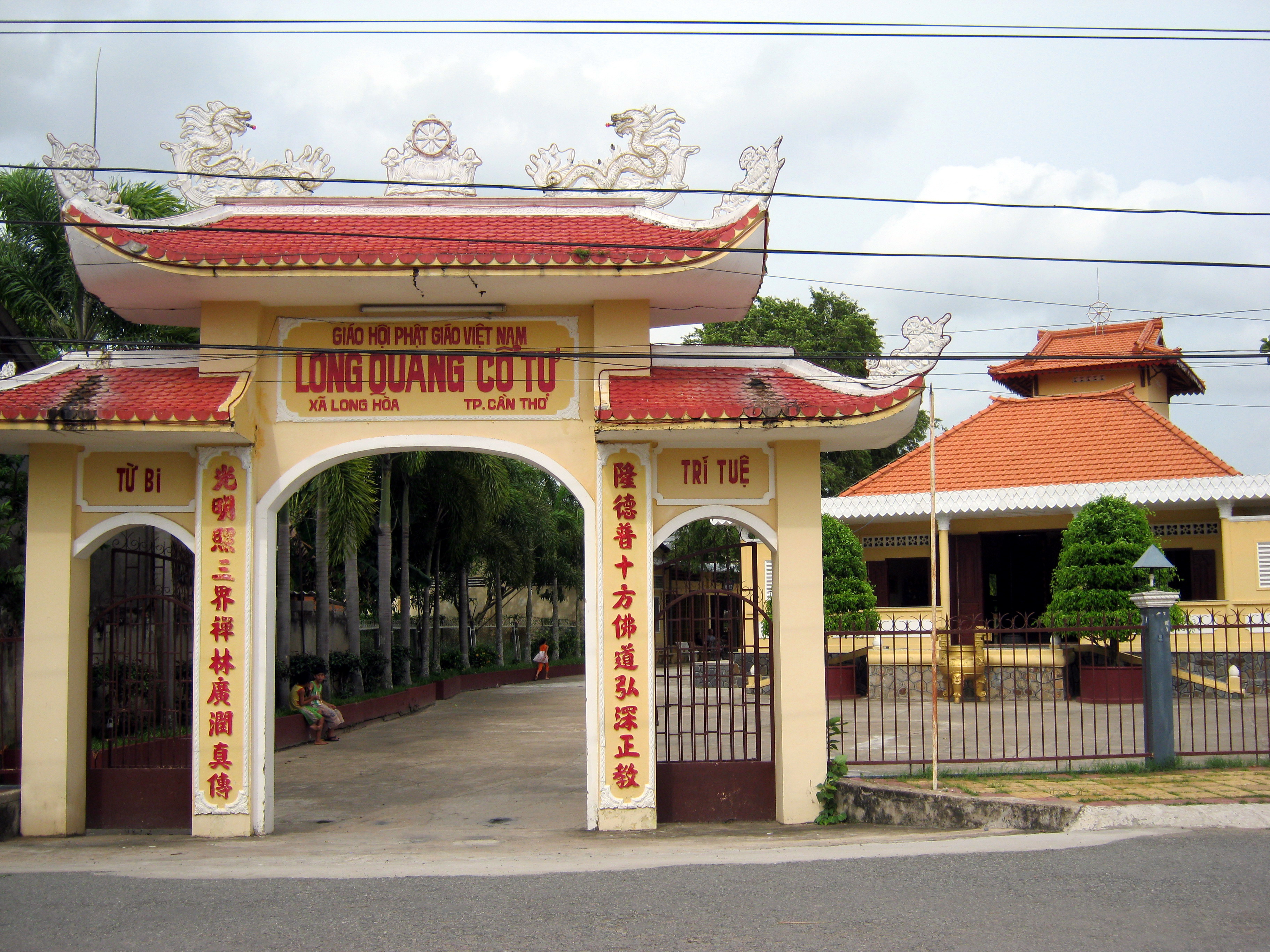
A brick triple-arched gate (tam quan) with two-tiered tiled roofs, the roof ends curved and decorated with patterns. On top of the roof are two white dragons raising their heads, facing inward towards the Dharma wheel in the centre. The two main pillars bear a pair of parallel sentences in Chinese characters.
The main hall (chánh điện) covers 324 m², built in the "Upper storey, lower veranda" (Thượng lầu Hạ hiên) architectural style (see photo 2), with tiled roof and brick walls, and has a total of five entrances (front: 2, back: 1, sides: 2).
Right in the centre is the main altar. Here, above hangs a wooden horizontal board intricately carved, in the centre are four Chinese characters: Đại Hùng Bảo Điện; below is a carved and gilded wooden frame with elaborate floral patterns, and on both sides are pairs of parallel sentences in Chinese characters.
The main altar is made of wood and has two levels. The upper level has three altar seats, enshrining three statues of the Buddhas of the Three Times (Amitābha, Mahāsthāmaprāpta, Avalokiteśvara) made of wood, each over one metre high, sculpted in sitting posture; the lower level enshrines a statue of Maitreya Bodhisattva.
In front of the upper level just mentioned is a statue of Shakyamuni Buddha entering nirvana, made of wood, one metre long, intricately carved. Opposite the main altar is the altar of Vi Đà Dharma Protector and Tiêu Diện Đại Sĩ (Ông Tiêu).
Against the right wall, on a long shelf, are arranged 9 Arhat statues, followed by the altar of Kṣitigarbha Bodhisattva, and behind that is the altar of the Jade Emperor (with Nam Tào and Bắc Đẩu on either side).
Against the left wall, on a long shelf, are arranged 9 Arhat statues (facing the 9 on the right), followed by the altar of Avalokiteśvara (with Thiên Tài and Đồng Tử on either side).
Behind the main altar is the Ancestral Altar. Above is a statue of Cundi Mother Buddha, below is a statue of Bodhidharma. Around are arranged ancestral tablets and portraits of former abbots of the pagoda. Against the walls on either side of the rear door are two altars: on the right, statues of Guan Yu, Giám Trai, etc.; on the left, statues of Yama, Dragon King, and Judges, etc.
Behind the main hall is the Stupa area, covering more than 2,000 m², planted with many ornamental flowers, bonsai, fruit trees, etc. This is where the ashes of former abbots are kept.
National Heritage Site
On 21 June 1993, the pagoda was recognised as a National Architectural and Artistic Monument, according to Decision No. 774/1993/QĐ-BT of the Ministry of Culture and Information.
Photos
📷 Contribute photosVisiting tips
- Dress modestly; remove hats and keep quiet inside the main hall.
- Incense, flowers and offerings are usually sold right outside the gate; light an odd number of sticks (1 or 3).
- Most pagodas open from early morning to evening and are free to enter (some major sites charge a small scenic fee).
- Full-moon days, the 1st of the lunar month and Tet are very crowded; visit on weekday mornings for a quiet experience.
- Ask permission before photographing inside shrines; do not touch statues or altar objects.
Read more & references
Useful links to learn more before your visit:
Location
Coordinates: 10.02530, 105.72009
🧭 Directions on Google MapsReferences
Other pagodas in Cần Thơ


