Khải Tường Pagoda
TP. Hồ Chí Minh(Chùa Khải Tường)
Overview & history
Khải Tường Pagoda is an ancient temple, formerly located on a high mound in Tân Lộc hamlet, in old Gia Định; today it is in the area of the War Remnants Museum, No. 28 Võ Văn Tần, District 3, Ho Chi Minh City, Vietnam. This can be considered one of the oldest Buddhist sanctuaries in that region, but it was destroyed during the French colonial period.
History
Around the year Giáp Ngọ (1744), Zen Master Phật Ý-Linh Nhạc (1725-1821, the person who first brought the Lâm Tế lineage of the Bổn Nguyên sect to southern Vietnam), obeyed his teacher and followed a group of migrants from Đồng Nai heading south. On the journey, the monk met another monk whose name is unknown, of the same age, and they became sworn brothers. Upon arriving at their new home, Tân Lộc village (some sources write it as Hoạt Lộc village or Chợ Đũi hamlet), the two monks cleared the forest and built a thatched hut (around 1744) to worship the Buddha. A few years later, the anonymous monk separated to establish his own hut, a few dozen metres from the old one, to facilitate his practice.
By the year Nhâm Thân (1752), Zen Master Phật Ý-Linh Nhạc renovated the thatched hut into a pagoda, naming it Từ Ân Pagoda, with the meaning "thanks to the compassion and grace of the Buddha, the people are at peace, able to create a prosperous and happy life in the new land". Around the same time, the anonymous monk also renovated his previous hut into a pagoda, naming it Khải Tường Pagoda, meaning "expanding blessings for the people". Therefore, when the French colonists invaded Gia Định, they called Khải Tường Pagoda the Front Pagoda (pagode Avancée, later also called pagode Barbé) and Từ Ân Pagoda the Rear Pagoda.
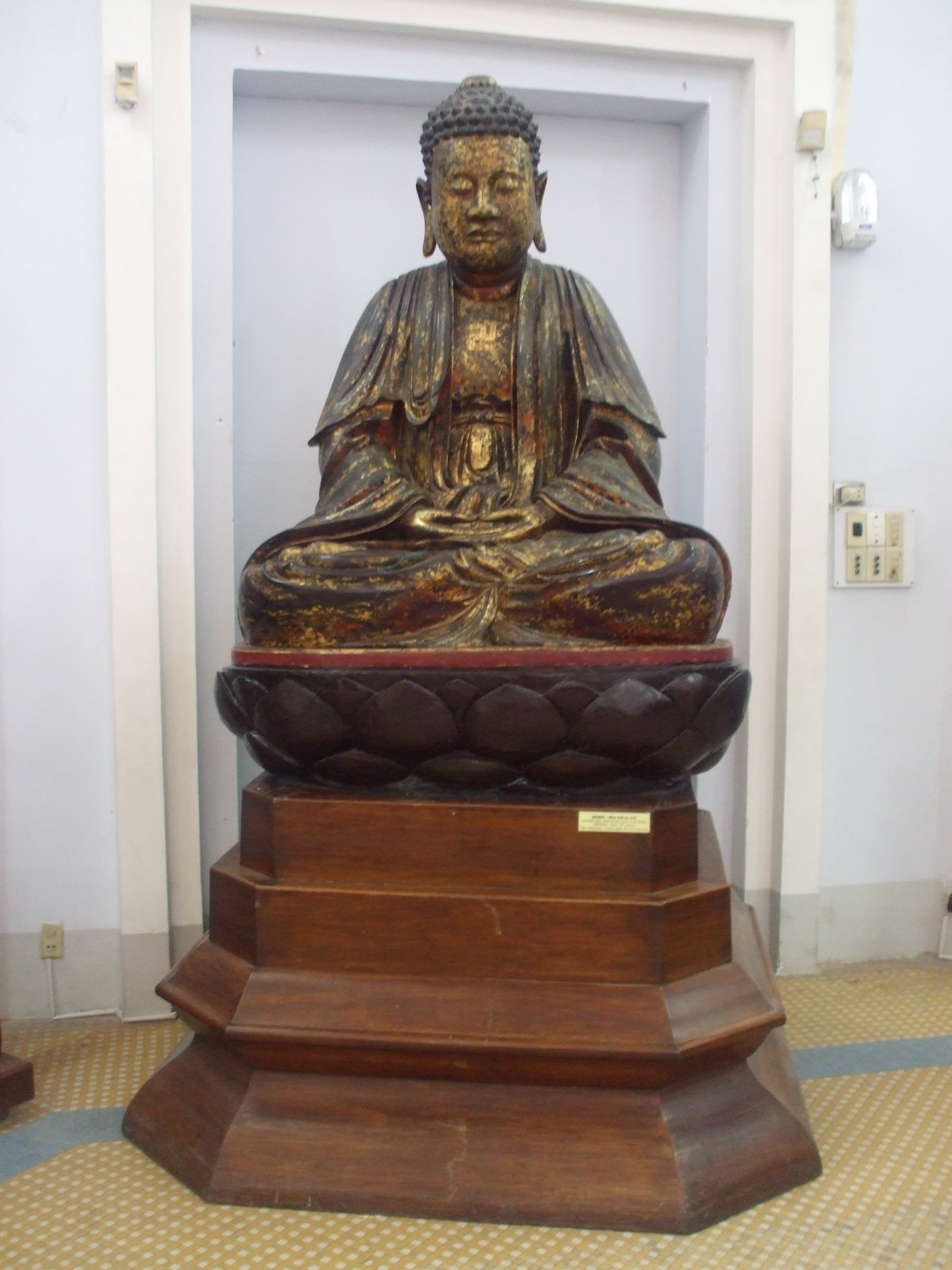
According to some sources, on the 23rd day of the 4th lunar month, year Tân Hợi (25 May 1791), Nhị phi Trần Thị Đang (Thuận Thiên Cao Empress) gave birth to Nguyễn Phúc Đảm (later Emperor Minh Mạng) in the rear quarters of Khải Tường Pagoda, when Lord Nguyễn Phúc Ánh came here to hide from the Tây Sơn army. In 1804, in gratitude for the protection, Emperor Gia Long (i.e. the above-mentioned lord) sent a large statue of Amitābha Buddha, seated on a lotus throne, 2.5 m high, made of jackfruit wood, lacquered and gilded, to be offered to the pagoda.
In 1832, to commemorate the place where his parents once lived, and also his birthplace, Emperor Minh Mạng ordered funds to be allocated for the restoration of the pagoda, and also arranged for "monks to reside, and granted temple fields" to take care of annual ceremonies.
In 1858, the French attacked Hàn Gate (Đà Nẵng). The following year (1859) they attacked Gia Định, and the French stationed troops scattered at Trường Thi, Hiển Trung Temple (pagode aux Mares) and the following pagodas: Khải Tường (pagode Barbé), Kiểng Phước (pagode des Clochetons), Cây Mai (pagode des Pruniers).
As for Khải Tường Pagoda, French Marine Captain Barbé was tasked with leading troops to occupy it. Barbé had the Buddha statue moved outside into the yard and forced the monks to leave the pagoda. At that time, Commissioner Nguyễn Tri Phương was sent by the court to the South to establish the Chí Hòa Citadel to resist the French, and on the evening of 7 December 1860, Vietnamese troops ambushed and killed Barbé, when the officer was riding his horse on a night patrol from Khải Tường Pagoda to Hiển Trung Temple (within the Ô Ma citadel).
French Navy Lieutenant Léopold Pallu, who came to Saigon to fight, later recounted:
"That afternoon, Marine Captain Barbet was patrolling on horseback as usual. The assassins lay in wait in a bush... He was suddenly attacked with a spear and fell from his horse. The Annamites immediately cut off his head, crawled through the bushes and tall grass, and returned to their old lines at Kỳ Hòa citadel. The next morning, the remainder of Barbet's body was found dragged to the roadside; his wounded horse lay motionless nearby. It is said that when the captain's head was brought and placed beside the betel tray of the Annamite general, the latter simply counted out the reward money without saying anything, then later uttered a word of regret. Captain Barbet had a strong, athletic build, and many Annamites recognised him..."
Later, according to the writer Sơn Nam, "Khải Tường Pagoda became a boys' school for training teachers. In 1880, Khải Tường Pagoda was dismantled, and the school moved to a new facility, Chasseloup Laubat School, completed around 1877." When dismantled, the horizontal board inscribed "Quốc ân Khải Tường tự" was transferred to Từ Ân Pagoda (now on Tân Hóa street, District 6, Ho Chi Minh City) for safekeeping, while the aforementioned Buddha statue was relocated several times, and finally displayed in the National Museum of Saigon, now the Ho Chi Minh City Museum of History.
Later, on this abandoned pagoda site, the French built a mansion for officials in the colonial administration. Before 1963, it was used as the University of Medicine and Pharmacy. After the overthrow of President Ngô Đình Diệm's regime, the generals allowed military advisers to be stationed there.
After 30 April 1975, the site was used as the War Remnants Museum.
Nàng Hai Bến Nghé
The name of Khải Tường Pagoda and the French Captain Barbé are also spread through the story of Nàng Hai Bến Nghé:
Nàng Hai and Tri loved each other, but due to difficult circumstances, she had to marry Commander Sắc.
Once, after losing a battle, Sắc was reprimanded by his superiors. Already in a bad mood, when he heard from spies that Tri often behaved intimately with his wife, Sắc became very jealous. One day, Sắc had someone impersonate his wife to invite Tri to the house on urgent business. When the two met, Sắc emerged from hiding, raised an alarm, accused them of adultery, and ordered soldiers to tie them to a raft and set them adrift on the river.
A day or two later, Captain Barbé, stationed at Khải Tường Pagoda, was out hunting and unexpectedly saw a banana raft floating by with a man and a woman on it. Following the current, two large, fierce crocodiles were thrashing their tails, chasing the raft. Barbé fired his gun, frightening the crocodiles away. When the raft was retrieved, the young man, Tri, had had a leg bitten off by a crocodile and was dead. The young woman, Nàng Hai, was barely alive. After being cared for, seeing that she was young and beautiful, Barbé forced her to live with him. Nàng Hai agreed on the condition that she be allowed to return home to settle personal affairs.
When Nàng Hai returned, Commander Sắc had her arrested on charges of collusion and prostitution with the enemy. Sắc imprisoned Nàng Hai in a deep pit, feeding her only fish bones and stale rice. Fortunately, Trương Định passed by on patrol, ordered her to be brought up, and listened to her tale of injustice...
At Khải Tường Pagoda, that evening, as dusk fell, the guards reported that Nàng Hai had come to ask for an audience. Barbé joyfully rode out to meet her. When he was about ten metres from the girl, Vietnamese soldiers ambushed from both sides of the road. The horse was speared and collapsed, throwing Barbé down, and he was immediately killed. That day was 7 December 1860.
More than two months later, French reinforcements from Shanghai arrived in Saigon in force. After several fierce battles, the Chí Hòa citadel was captured. After those days of smoke and fire, no one could find the girl anywhere, not knowing whether she lived or died. But among the people, the image of the woman set adrift on the river, who contributed to the resistance against the French, is still remembered.
Related Information
After Captain Barbé's death, the French were very angry. Therefore, they seized a stone stele (inscribed with an epitaph composed by Phan Thanh Giản in 1858) that Emperor Tự Đức had sent from Huế to Gò Công to be erected at the tomb of his maternal grandfather, Duke Phạm Đăng Hưng, and used it as Barbé's tombstone in the old Mạc Đĩnh Chi Cemetery. It was not until 1999 that the stele was erected at Mr. Hưng's grave, meaning that this stone stele, bearing the names of two deceased men, one French and one Vietnamese, was displaced for exactly 140 years (1859-1999).
Main References
Thích Thanh Từ, Vietnamese Zen Masters. Thành hội Phật giáo TP. Hồ Chí Minh Publishing, 1992.
Sơn Nam, Old Bến Nghé. Văn Nghệ Publishing House, Ho Chi Minh City, 1981
Nguyễn Hiền Đức, History of Buddhism in Đàng Trong. Ho Chi Minh City Publishing House, 1995.
Phan Thứ Lang, Sài Gòn in the Old Days, Hồ Chí Minh Publishing House, 2001, pp. 50-57.
Articles in the book "Scientific Conference on 300 Years of Buddhism in Gia Định-Sài Gòn-Ho Chi Minh City" (abbreviated as "Conference"), Ho Chi Minh City Publishing House, 2002, including:
-Thiền Hòa tử Huệ Chí, "The Early Days of Buddhism in Gia Định-Sài Gòn".
-Trần Hồng Liên, "The Role of Từ Ân Pagoda in the Development of Buddhist Culture in Gia Định".
-Huỳnh Ngọc Trảng, Lost Ancient Temples in Old Gia Định.
-Nguyễn Quảng Tuân, Architecture of Ancient and Modern Pagodas.
Photos
📷 Contribute photosVisiting tips
- Dress modestly; remove hats and keep quiet inside the main hall.
- Incense, flowers and offerings are usually sold right outside the gate; light an odd number of sticks (1 or 3).
- Most pagodas open from early morning to evening and are free to enter (some major sites charge a small scenic fee).
- Full-moon days, the 1st of the lunar month and Tet are very crowded; visit on weekday mornings for a quiet experience.
- Ask permission before photographing inside shrines; do not touch statues or altar objects.
Read more & references
Useful links to learn more before your visit:
References
Other pagodas in TP. Hồ Chí Minh
